

Humanoid Robots Just Ran a Half-Marathon Faster Than You
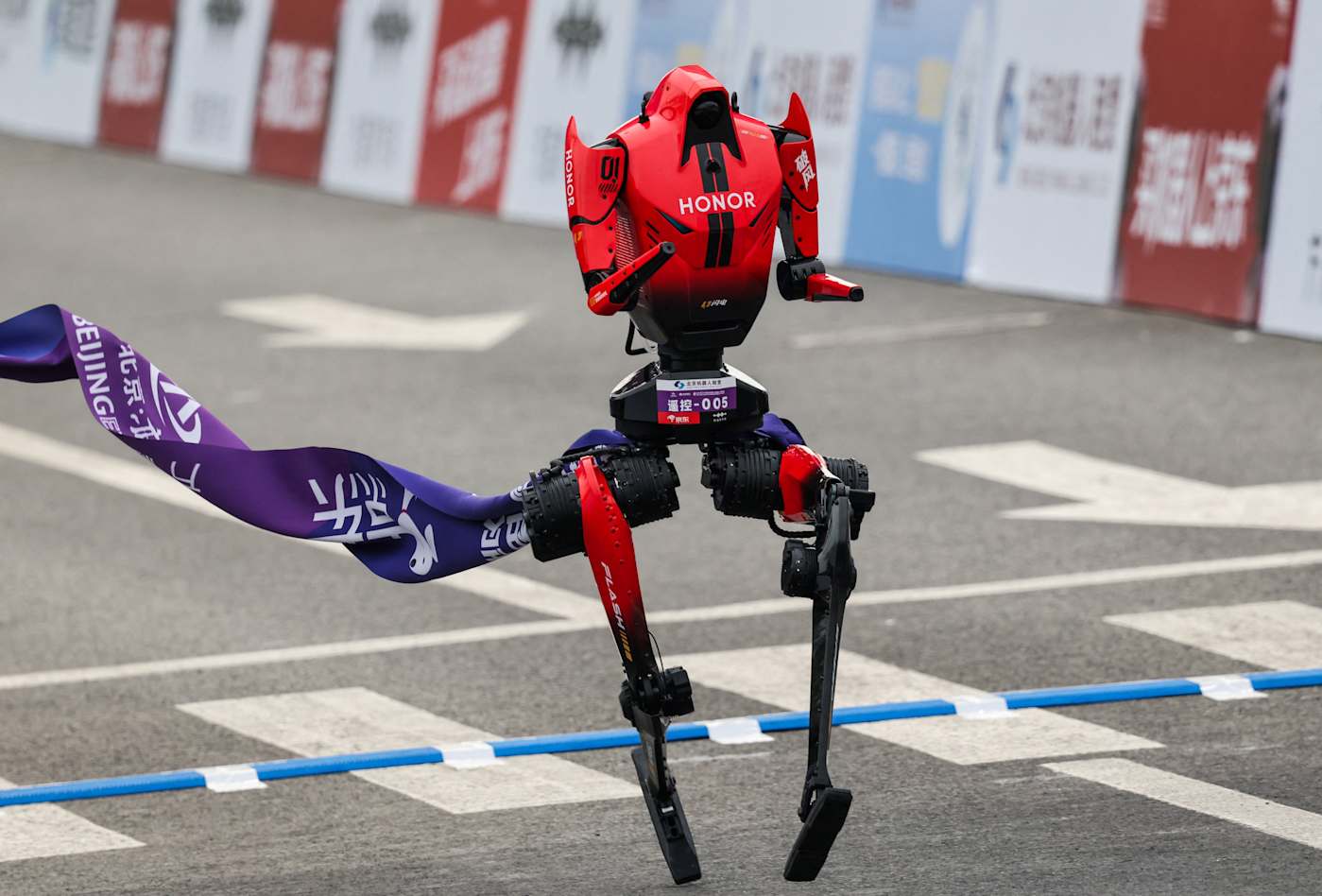
Last week in Beijing, a humanoid robot named Lightning crossed the finish line of a half-marathon in 50 minutes and 26 seconds. That's faster than the human world record. Let that sink in.
This wasn't a carefully choreographed demo in a controlled lab environment. This was a competitive race, the second annual event of its kind, and the results marked a dramatic leap from last year's inaugural attempt, which was apparently filled with mishaps. About 40% of the competing robots successfully completed the course this time around, suggesting we've crossed a threshold from "can these things even run?" to "how fast can they go?"
The robotics community has spent years celebrating every incremental achievement in bipedal locomotion. Boston Dynamics videos of Atlas doing parkour go viral because watching a robot maintain balance while jumping is genuinely impressive. But running a half-marathon is a different category of challenge entirely. It's not about a burst of coordinated movement or a carefully planned sequence of motions. It's about sustained performance, energy management, thermal regulation, and mechanical endurance over 13.1 miles.
What makes Lightning's achievement particularly significant is what it reveals about the maturation of core technologies. The battery capacity, power efficiency, joint durability, and real-time balance algorithms all had to work flawlessly for nearly an hour. Any single point of failure—a motor overheating, a control system glitch, a battery drain—would have ended the race. The fact that multiple robots completed the course suggests these aren't one-off engineering miracles but increasingly reliable platforms.
This comes at a fascinating moment for humanoid robotics. While companies like AGIBOT are deploying semi-humanoid robots in electronics manufacturing with impressive success rates, the humanoid form factor has often been questioned as impractical for most applications. Why build legs when wheels are more efficient? Why replicate human anatomy when you can optimize for the specific task?
But endurance running makes the case for humanoid design in a way that factory floor applications never could. It demonstrates that bipedal robots can now handle dynamic, unpredictable environments with the kind of robust performance that was purely theoretical a few years ago. If a robot can maintain stability and efficiency through a half-marathon—dealing with varying terrain, wind conditions, and the chaos of a competitive field—it can potentially handle the messy reality of human-designed spaces that weren't built with robots in mind.
The timing is also worth noting. As the industry pushes toward deploying humanoids in warehouses, retail, and service environments, proving they can literally go the distance addresses one of the biggest practical concerns: durability under sustained use. A robot that breaks down every few hours isn't useful in real-world applications, no matter how impressive its demonstration videos.
Of course, beating a human half-marathon record doesn't mean Lightning could navigate a crowded subway platform or climb a ladder on a construction site. But it does mean we've entered a new phase where humanoid robots aren't just mimicking human movement—they're beginning to exceed human physical capabilities in specific domains.
The question now isn't whether humanoid robots can run. It's what they'll be running toward, and how quickly the gap between laboratory capabilities and practical deployment will close. Based on what just happened in Beijing, that gap is shrinking faster than anyone expected.