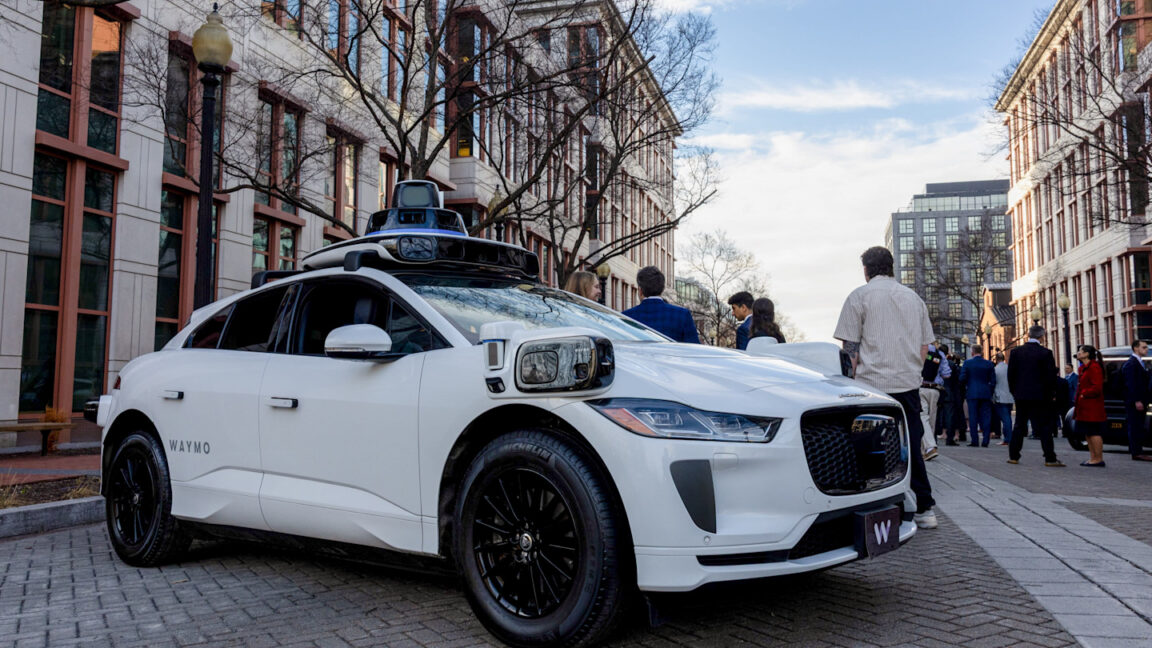


Waymo doubles spending on lobbying in robotaxi battle with Uber
Alphabet-owned company is seeking to persuade US regulators to clear a path for fully autonomous taxi services.
50 articles found

Alphabet-owned company is seeking to persuade US regulators to clear a path for fully autonomous taxi services.
Florent Delgrange won the Best Blue Sky Paper Award at AAMAS 2026 for research on foundation world models that enable autonomous agents to learn and adapt reliably in changing environments while maintaining safety guarantees. The work proposes integrating reinforcement learning with formal verification methods, creating structured world models that can be reused across tasks and updated safely as environments evolve.

After decades of flashy combat robot demos, autonomous systems are quietly revolutionizing the unglamorous work of military supply chains. From the U.S. Army's TALUS project to autonomous trucking partnerships, defense logistics is becoming the proving ground for practical robotics.

While the industry obsesses over humanoids and autonomous trucks, researchers at EPFL quietly cracked a fundamental challenge: how to make truly small robots move efficiently. The answer involves sound waves, and it might matter more than you think.
The U.S. Army has awarded Stratom Inc. a $15.9 million Project Sustainment contract to develop TALUS (Tactical Autonomous Logistics Utility System), a modular autonomous distribution system designed to autonomously resupply dispersed military forces in contested environments. The system integrates robotics, autonomous logistics, and commercial off-the-shelf technology to reduce soldier exposure to threats while maintaining supply flow, with an 18-month prototype phase culminating in operational evaluation at a Combat Training Center rotation.

Three major autonomous trucking announcements hit in the same week, signaling that the long-promised self-driving freight revolution might finally be real. But the timing raises questions about whether the technology is truly ready, or if investors are simply betting on the same hype cycle.

The robotics industry is experiencing a quiet inversion: software companies are increasingly driving hardware innovation, while traditional manufacturing plays catch-up. From OpenAI's enterprise AI deployment to autonomous trucking milestones, the people writing code are now dictating what machines get built.
Celona announced Celona Orion, a unified agentic wireless platform that converges private 5G, Wi-Fi, public cellular, and satellite connectivity for physical AI applications including autonomous vehicles and mobile robots. The platform enables seamless network switching for robots and autonomous systems while simplifying infrastructure management through a single pane of glass, and includes an open-source agent (AerConnect) for robotics manufacturers.

In the past week alone, defense-focused robotics companies raised nearly $1.7 billion while civilian applications scrambled for scraps. The money flooding into military autonomous systems isn't just changing who builds robots — it's reshaping what gets built and why.

As physical AI systems and autonomous robots proliferate across warehouses, factories, and outdoor environments, we're discovering that connectivity infrastructure is woefully unprepared. From Celona's new unified wireless platform to safety webinars about shared spaces, the industry is scrambling to solve a problem most companies didn't see coming.
Einride and DAF Trucks have partnered to integrate Einride's autonomous driving system with DAF's premium truck platform, targeting SAE Level 4 autonomous electric freight transportation. The collaboration will involve testing in 2026 and integration by 2027, with support from Dutch research institute TNO to ensure safety and regulatory compliance for autonomous operations on public roads.
OpenAI research examines how enterprises are adopting agentic AI systems, including ChatGPT and Codex, with a focus on how leading companies are implementing AI agents for task execution. The report reveals patterns in enterprise AI adoption and the growing gap between frontier firms and lagging competitors in deploying autonomous AI systems.
Cambridge Aerospace, a defense drone developer founded in 2024, raised $300 million in Series C funding at a $3.4 billion valuation to expand manufacturing and develop air defense systems. The company's Skyhammer product is a drone-based interceptor system with autonomous threat detection and neutralization capabilities, with a next-generation product called Starhammer planned for 2027 launch.
PlusAI announced updated commercial readiness metrics for H1 2026, showing progress toward deploying factory-built autonomous trucks at scale in 2027, including improvements in safety validation, autonomous miles percentage, and remote assistance-free trips. The company launched commercial trials with International and Ryder in Texas, expanded operations to Southern Europe, released SuperDrive 6.0 with enhanced capabilities including night driving, and expanded partnerships with NVIDIA and international logistics operators.
A report examines the growing market for autonomous mobile robots (AMRs), which is projected to expand from $5 billion in 2024 to $14 billion by 2030, driven by labor costs, operational flexibility needs, and technological advances. Recent improvements in AMRs are enabled by computer vision, sensor fusion, machine learning, and AI-powered fleet management, with applications expanding into manufacturing, pharmaceuticals, and other sectors beyond traditional warehouse logistics.
A free webinar scheduled for August 26 will bring together warehousing and robotics experts to discuss safety best practices for deploying and scaling autonomous mobile robots (AMRs), automated guided vehicles (AGVs), and autonomous forklifts in shared human-robot warehouse environments. The panel will address risk assessment strategies, collision avoidance, and approaches to maintaining productivity while ensuring worker safety during fleet operations.
Hadrian Automation has raised $1.37 billion in Series D funding to accelerate its AI-powered, highly automated factory network for U.S. defense and aerospace manufacturing. The company, valued at $7.87 billion, plans to expand its manufacturing footprint using robotics, machine learning, and process engineering to rebuild domestic production capacity for mission-critical systems including munitions and autonomous systems.

From quadrupeds inspecting factories to desktop bots with radar sensors, a quiet revolution is underway: robots are getting smarter by keeping their brains local. The shift to edge AI isn't just a technical upgrade—it's rewriting the economics and capabilities of autonomous systems.
Huntington Ingalls Industries (HII) signed long-term performance-based agreements with Path Robotics and GrayMatter Robotics, worth up to $900 million over seven years, to deploy robotic welding and sanding systems in U.S. Navy shipbuilding. The companies will develop and integrate physical AI-powered autonomous production techniques across complex naval fabrication processes including welding, grinding, painting, and assembly, with HII planning to outsource 2.5 million hours of shipbuilding work by 2026.
Avnet and Weston Robot have partnered to launch an edge AI-powered autonomous inspection platform using quadruped robots equipped with AMD Ryzen AI processors. The system performs real-time inspections in industrial environments by processing AI workloads at the edge, enabling low-latency inference, thermal and visual analytics, and 3D lidar mapping without relying on cloud connectivity.

While humanoids dominate headlines and venture capital, autonomous maritime systems are quietly entering production and winning government contracts. From Navy deep-sea surveys to autonomous cargo vessels, the ocean robotics sector is scaling faster than its landlocked counterparts — with far less fanfare.
Moove raised $250 million in Series C funding to build infrastructure for autonomous vehicles, including robotics-first depot facilities called 'Nests' for charging, servicing, and fleet orchestration. The company plans to expand its autonomous vehicle workforce by over 220% and launch operations globally, leveraging its existing platform from managing 42,000 human-driven vehicles across 29 cities to support autonomous mobility at scale through partnerships like Waymo.
Autonomous Solutions Inc. CEO Mel Torrie discusses how advanced perception and vision systems are becoming critical to scaling industrial autonomy beyond simple automation. The article emphasizes the importance of hardware-agnostic vision upgrades, edge intelligence processing, and perception systems specifically designed for harsh real-world industrial conditions rather than adapted from consumer platforms.

From ocean floor mapping to drone deliveries and autonomous taxis, 2026 marks the year when autonomous systems moved from pilot programs to actual commercial operations at scale. The transition reveals as much about regulatory readiness as technological capability.
Zoox, an Amazon subsidiary, unveiled the final production design of its purpose-built robotaxi after gathering feedback from over 500,000 riders. The company plans to scale production to 100 vehicles per week and expand autonomous taxi service from Las Vegas to Austin, Miami, Dallas, and Phoenix, while coordinating with NHTSA for full regulatory approval.
Blue Water Autonomy has been selected by the U.S. Navy's Naval Oceanographic Office for a $40 million contract to conduct high-resolution ocean floor mapping using long-endurance autonomous surface vessels across the Indian and Pacific oceans. The company, founded in 2024, integrates hardware, software, and AI into its Liberty Class autonomous ships, which can operate for months at sea with ranges exceeding 10,000 nautical miles, reducing operational costs and personnel risk compared to crewed survey vessels.

The FCC's sudden restrictions on foreign humanoid and mobile robot imports mark a turning point in how governments view autonomous systems — not as toys or industrial tools, but as critical infrastructure with genuine security implications. After years of letting the industry self-regulate, policymakers are scrambling to catch up.
Carnegie Mellon University researchers have received DOE funding through the Genesis Mission to develop AI-based tools that enable autonomous laboratories to operate as an interconnected research ecosystem, advancing scientific collaboration and discovery.
The article examines five foundational physical AI infrastructure platforms shaping robotics development in 2026, including NVIDIA's accelerated computing and simulation ecosystem (Isaac, Newton), and Applied Intuition's validation engineering for autonomous systems. These platforms represent critical layers in the emerging physical AI stack, addressing bottlenecks in robot perception, reasoning, action, and real-world deployment across industries like automotive, manufacturing, and autonomous vehicles.
DoorDash has received FAA Part 135 air carrier certification, becoming one of only eight drone operators in the U.S. to achieve this status, and is launching DoorDash Air as an in-house drone delivery program. The company is building a full stack of autonomous delivery infrastructure including its own UAVs, ground handoff systems, and an Autonomous Delivery Platform that routes orders across multiple delivery modes including drones, robots, and human dashers. DoorDash's drone pilots have shown average delivery times of 25 minutes and sustained order volume growth of 30% in participating locations.

Microsoft unveiled new AI security tools, including MAI-Cyber-1-Flash and Project Perception, designed to identify and fix software vulnerabilities and automate security threat detection. The announcement comes after OpenAI's security models were compromised in a high-profile hack of Hugging Face, raising questions about safeguards for autonomous AI systems.
Kraken Technology Group raised $175 million in Series B funding, reaching a $1 billion valuation, to accelerate production and deployment of autonomous maritime vessels for defense applications. The UK-based company develops uncrewed surface vessels (USVs) and subsurface vessels (USSVs) for NATO and allied forces, with backing from DTCP, NATO Innovation Fund, and strategic manufacturing partnerships with Rheinmetall, Anduril, and others.
Researchers at the University of Basel have developed a miniature dental robot called MIR (Miniature Intraoral Robot) designed to prepare teeth for crowns with high precision. The cork-sized robot can achieve positional accuracy within 0.2 millimeters and could reduce the number of dental appointments needed by allowing dentists to plan and order permanent crowns immediately after a scan, with further development planned to integrate sensors and cameras for autonomous operation.
AMD unveiled its Ryzen AI Embedded X100 series and Kria AI Robotics platform designed to provide deterministic real-time control and unified CPU-GPU-NPU memory for robotics applications. The company claims the X100 outperforms NVIDIA's Orin and Thor on system-level robotics workloads while supporting industrial arms, autonomous mobile robots, and humanoids on a single scalable platform.

Tesla has revealed its upcoming Cybercab autonomous vehicle design featuring a built-in SpaceX Starlink V5 satellite internet dish alongside GPS and 5G LTE connectivity. The integration aims to provide redundant internet access and enable fleet-level communication capabilities for autonomous taxi operations, though the practical necessity remains unclear given widespread 5G coverage in urban deployment areas.
Burro AI discusses the engineering challenges of deploying autonomous robots in unpredictable, uncontrolled outdoor environments like agriculture, ports, and construction sites. The company argues that real-world robotics deployment requires learning from actual operational conditions rather than relying on controlled demos and simulations, emphasizing the need for reliability and adaptability across extreme environmental variability.
Boston Dynamics is hosting a free webinar on human-robot interaction design, featuring experts who will discuss how to build trust and safety into humanoid robots through predictability rather than human mimicry. The session will cover communicating robot intent, safety design for autonomous operation, the role of large language models in natural interactions, and leveraging mechanical form over human-like appearance, using their Atlas humanoid as a case study.

At SIGGRAPH 2024, NVIDIA showcased advances in neural rendering, world models, and AI-powered simulation technologies applicable to robotics, autonomous systems, and digital twin design. Key announcements include breakthroughs in 3D-guided neural rendering, AI physics models for weather and aerodynamics, and the Cosmos world foundation model platform for developing physical AI systems.

Zoox's recall of 105 robotaxis for failing to navigate smoke might sound alarming, but it reveals something encouraging: the autonomous vehicle industry is finally being honest about its limitations and treating safety gaps like the serious engineering problems they are.
This article critiques the robotics industry's heavy reliance on teleoperation and human demonstration for training robots, arguing that this approach hits fundamental scaling limits. The author contends that teleoperation datasets are orders of magnitude smaller than those used for language models, quality is poor, and the real world's constant variations require infinite new demonstrations—making it essentially a permanent labor system rather than a path to autonomous robots. The piece suggests reinforcement learning in synthetic environments, as used for language models, may be a more promising approach for achieving genuine robot generalization.

Zoox has issued a software recall for 105 robotaxis due to their inability to safely navigate through heavy smoke, after a vehicle interfered with an active fire emergency in June. The recall addresses a gap in the autonomous vehicle's perception and response capabilities, reflecting growing regulatory pressure from the NHTSA for robotaxi companies to better handle emergency situations.
Weave Robotics has launched Isaac 1, a wheeled home humanoid robot priced at $7,999 or $449/month, designed to handle household tasks like laundry folding, tidying, and bed-making. The robot features adjustable height (3-5.9 ft), autonomous navigation, eight-hour battery life, and privacy-focused design elements including camera shutters and a charging privacy screen, with deliveries beginning this fall.

Three major funding rounds in just days signal a sudden influx of capital into construction robotics. After years of pilot projects and skepticism, investors are betting that autonomous bricklayers, excavators, and panel installers are finally ready for scale.
Monumental, an Amsterdam-based construction robotics company, raised $32 million in Series B funding to expand to the U.S. market and expand its autonomous brick-laying robots' capabilities beyond masonry work. The company's electric robots use computer vision and AI software to lay bricks with millimeter precision, and have already completed over 100 homes and various structures across Europe.
Cornell University undergraduates won The Farm Robotics Challenge with an autonomous robot that uses electricity to kill weeds in vineyards and orchards without herbicides or human operators. The winning team is forming a startup called Rootline Robotics with their $50,000 prize to commercialize the low-energy weeding technology, addressing a major labor-intensive challenge for organic growers.

More than half of enterprises have already experienced AI agent security incidents, yet most are deploying autonomous systems faster than they can secure them. The gap between AI ambition and security readiness reveals an uncomfortable truth about the current state of enterprise AI adoption.
TerraFirma, founded by former SpaceX engineers, raised $115 million in Series A funding to expand its semi-autonomous heavy equipment platform for construction. The startup has developed a full-stack system combining AI-enabled software, remote command centers, and retrofitted excavators and dozers that allow skilled operators to control multiple machines simultaneously, increasing operator effectiveness by up to 300% while improving safety and project speed.

A study of 157 enterprise organizations reveals a critical gap between AI agent capabilities and evaluation reliability, with companies increasingly deploying autonomous agents to production despite doubting their own testing methodologies. Half of surveyed enterprises have already shipped agents that passed internal evaluations, raising concerns about the mismatch between perceived agent performance and actual real-world reliability.

Researchers at KAIST developed a four-legged robot named HOUND with a new control technology called APT-RL that enables it to autonomously select and switch between walking, running, jumping, and other locomotion skills in real-world environments. The system uses reinforcement learning and simulation-based training to allow the robot to adapt to complex outdoor obstacles like stairs, gaps, and forest terrain without requiring individual gait controllers.

Fujitsu, Nvidia, and Japan's leading robotics manufacturers (Fanuc, Yaskawa, Kawasaki Heavy Industries) announced a major collaboration to develop "physical AI" — autonomous robots that can think independently and work alongside humans in factories, homes, and hospitals. The initiative aims to address Japan's labor shortage by combining Nvidia's AI technology with Japanese manufacturing excellence, with the first phase of collaboration expected later in 2026.