
Introducing GPT-6.2 Astra and Sol
Introducing GPT‑6.2 Astra and Sol, with better professional outputs, coding, computer use, and efficiency at lower cost across ChatGPT Work, Codex, and the API.

50 articles found
Introducing GPT‑6.2 Astra and Sol, with better professional outputs, coding, computer use, and efficiency at lower cost across ChatGPT Work, Codex, and the API.
Researchers at IRIDIA have developed a method to successfully transfer reinforcement learning-trained robot swarms from simulation to real-world robots by constraining the learning algorithm to choose among predefined behaviors rather than controlling motors directly. This approach overcomes the "reality gap" problem where simulated robot behaviors fail in physical environments, as demonstrated through 250 experiments with a 20-robot e-puck swarm across five different collective missions.
Explore the new Sales plugin and 30+ new and expanded partner plugins in ChatGPT to research prospects, prepare pitches, update your CRM, and move deals forward.
OpenAI has partnered with the Government of Chile to promote responsible AI adoption across the public sector, develop local AI skills, and support startups in building AI applications. The initiative aims to help Chile leverage artificial intelligence technologies for economic and social development.
IEEE has released recordings of keynote and plenary talks from IROS 2026, the International Conference on Intelligent Robots and Systems held in Pittsburgh in September-October 2026. The available videos cover diverse robotics topics including autonomous surgery, soft robotics, disaster robotics, manipulation systems, and embodied AI, featuring presentations from leading researchers and industry experts.
OpenAI is introducing computer-use agents and clinical improvements to ChatGPT for Healthcare, along with new plugins designed to integrate with existing healthcare software systems. These enhancements aim to enable AI assistants to perform actual clinical workflows and administrative tasks across healthcare platforms.
The King's Trust and OpenAI have announced a £1 million partnership aimed at providing practical AI skills training to up to 25,000 young people across the UK. The initiative focuses on preparing young people for employment in an AI-driven economy through educational programs and skill development.

DeepMind announced AlphaGenome 2, a next-generation AI model that predicts how DNA sequences and genetic variants affect specific human cell types, trained on over 100 million individual cell profiles across 68 tissues. The model identifies nearly twice as many variants that change gene expression compared to its predecessor and enables researchers to predict variant effects in disease-relevant cells, potentially accelerating discoveries in rare diseases and complex traits.
Amazon introduces Mitra-v2, an improved tabular foundation model pretrained on synthetic data that can adapt to new business tables without retraining. The model advances on the TabArena benchmark by scaling synthetic pretraining to larger tables with more rows and columns, and introduces new synthetic data generation methods to improve generalization across diverse prediction tasks.
OpenAI has introduced Control Room, a system designed to monitor and manage AI model workloads across its research infrastructure, with the capability to rapidly halt operations when safety or security issues are detected. The tool represents an approach to maintaining human oversight and control over large-scale AI systems during development and deployment.
OpenAI has developed Control Room, a central system for monitoring and managing model workloads across its research infrastructure, with the ability to rapidly halt operations in response to safety or security concerns. This internal tool represents an approach to AI governance and operational safety within large-scale AI research environments.

A critical code-execution vulnerability (CVE-2026-97631) with a 9.5/10 severity rating has been discovered in TianoCore EDK II, the open-source UEFI firmware used by most of the world's servers and data centers. The 16-year-old buffer overflow flaw in the PXE-Base Code driver allows attackers with network access to execute malicious code before the operating system boots, potentially compromising disk encryption and the Trusted Platform Module (TPM). The vulnerability was prematurely disclosed after AMI published a pull request containing the fix, complicating coordinated patching efforts across millions of devices.
The article discusses how ChatGPT and Codex AI models are being applied to accelerate engineering workflows in CAD, PCB design, and simulation for physical systems. This represents an application of large language models and AI to improve productivity in robotics and automation-adjacent engineering domains.
Discover how Heimstaden uses OpenAI's ChatGPT Enterprise and Codex to transform property management, cut costs, and empower employees across Europe.
Amazon announced TorchNeuron, an open-source PyTorch backend that enables AI developers to run PyTorch models on AWS Trainium chips with minimal code changes. The development process leveraged agentic AI to analyze hundreds of thousands of open-source models and identify representative architectures, allowing the team to optimize TorchNeuron's performance across diverse workloads through innovations like adaptive eager mode and multi-level caching.
Cisco is integrating OpenAI's models with its network intelligence capabilities to enhance enterprise security and develop more adaptive defense systems. The partnership leverages AI to strengthen threat detection and response at scale across network infrastructure.
Qodo has developed Codex, an AI-powered code review tool that integrates company-specific knowledge and coding standards to help developers identify critical issues across repositories before pull requests. The tool leverages AI to provide contextual code review assistance tailored to organizational practices and standards.
Amazon partnered with independent nonprofit AVERI to conduct third-party review of its internal AI safety evaluation datasets, validating strengths in topical coverage and testing diversity while identifying areas for improvement. In response, Amazon made concrete changes including refreshing test sets with harder adversarial scenarios, introducing difficulty-calibration frameworks, establishing quarterly reviews, and expanding multilingual prompt coverage across safety categories.
OpenAI and ServiceNow announced an expanded partnership integrating OpenAI's models and AI agents into ServiceNow's enterprise workflow platform, while also bringing ServiceNow workflows into ChatGPT and Codex. This partnership aims to enable enterprises to deploy AI-powered agents across business processes and operational workflows.
CodeRabbit integrates GPT-6.1 Sol to enhance security analysis in complex codebases, employing an AI security agent that helps developers identify risks and evaluate proposed fixes. The tool leverages advanced language models to strengthen code review and vulnerability detection processes.

Anthropic warns that advances in small AI models could enable self-replicating malware capable of autonomously spreading across IoT devices like smart fridges and vacuum cleaners by next year. The company's research demonstrated that lightweight models can run inference on low-cost hardware and potentially create AI-powered worms that dynamically adapt to unfamiliar devices, making them harder to shut down than traditional malware since they lack a centralized point of failure.
OpenAI has released usage data from ChatGPT Signals tracking 165 work activities across nearly 100 countries, providing insights into how professionals use the AI tool for work and how adoption patterns evolve over time. The data reveals trends in ChatGPT's integration into various workplace tasks and geographical variations in usage patterns.
Fanatics uses OpenAI to help fans complete their game-day outfits with Shop the Look. Testing across roughly 30,000 MLB products showed 10% higher engagement.
Researchers present UNCAP, a neurosymbolic framework enabling cooperative autonomous vehicles to communicate using natural language instead of raw sensor data. The system teaches vehicles which neighboring cars to trust and how much weight to give their messages, addressing challenges of scale, heterogeneous hardware, and bandwidth constraints in multi-vehicle coordination.
Patch the Planet connects security researchers, maintainers, and incident responders to help address critical vulnerabilities across open source.
Learn how OpenAI is improving ChatGPT across low-resource programming languages, with new evaluations for software engineering, SQLite, and COBOL migration.
Google DeepMind announced the broad rollout of Gemini 4 Argon, an advanced AI model with frontier-level cybersecurity capabilities designed to help defenders find and patch vulnerabilities. The company implemented multi-layered safety guardrails including input screening, internal introspection monitoring, and continuous oversight to prevent misuse in high-risk domains like cybersecurity and biology while ensuring the model operates reliably on complex real-world tasks.
Itaú, a major Brazilian bank, is implementing an AI-first strategy through ia.i, a conversational interface, and the IARA governance platform to serve customers and employees across its organization. The bank is deploying generative AI solutions while navigating Brazil's strict financial regulations.
New analysis reveals that agentic AI adoption is expanding across EU enterprises and small businesses, with emerging opportunities for deeper implementation to unlock additional value. The report examines current trends in autonomous AI agents and their growing deployment in European organizations.
Google announces Gemini 4 Argon, a general-purpose physical reasoning AI model for robotics that scores 87% on embodied reasoning benchmarks. Argon demonstrates capabilities across robot control (including Boston Dynamics Spot manipulation tasks), real-to-sim conversion, physical understanding, and iterative self-improvement through simulation and hardware deployment.
Oracle is leveraging ChatGPT and Codex to automate workflows across recruiting, engineering, and operations, enabling the company to convert labor-intensive tasks into rapid, repeatable processes. The implementation demonstrates practical applications of large language models and code generation AI in enterprise automation.
Google DeepMind has released EmbeddingGemma 2, a lightweight multimodal embedding model with 740 million parameters that natively maps text, images, audio, and video into a unified embedding space. The model achieves best-in-class performance for its size across benchmarks, offers significant storage efficiency through Matryoshka Representation Learning, and is optimized for on-device inference with minimal memory requirements, enabling privacy-first applications like semantic search and retrieval-augmented generation (RAG) pipelines.
Atlassian and OpenAI are expanding their partnership to integrate OpenAI's frontier AI models with Atlassian's enterprise software platform, enabling teams to leverage AI for planning, building, and delivering work. The collaboration aims to connect advanced language models with organizational knowledge to improve productivity and decision-making across enterprises.
Hundreds of academics and industry leaders in robotics toured Carnegie Mellon's robotics and engineering facilities on Oct. 1 to see what Carnegie Mellon University researchers are working on inside t...
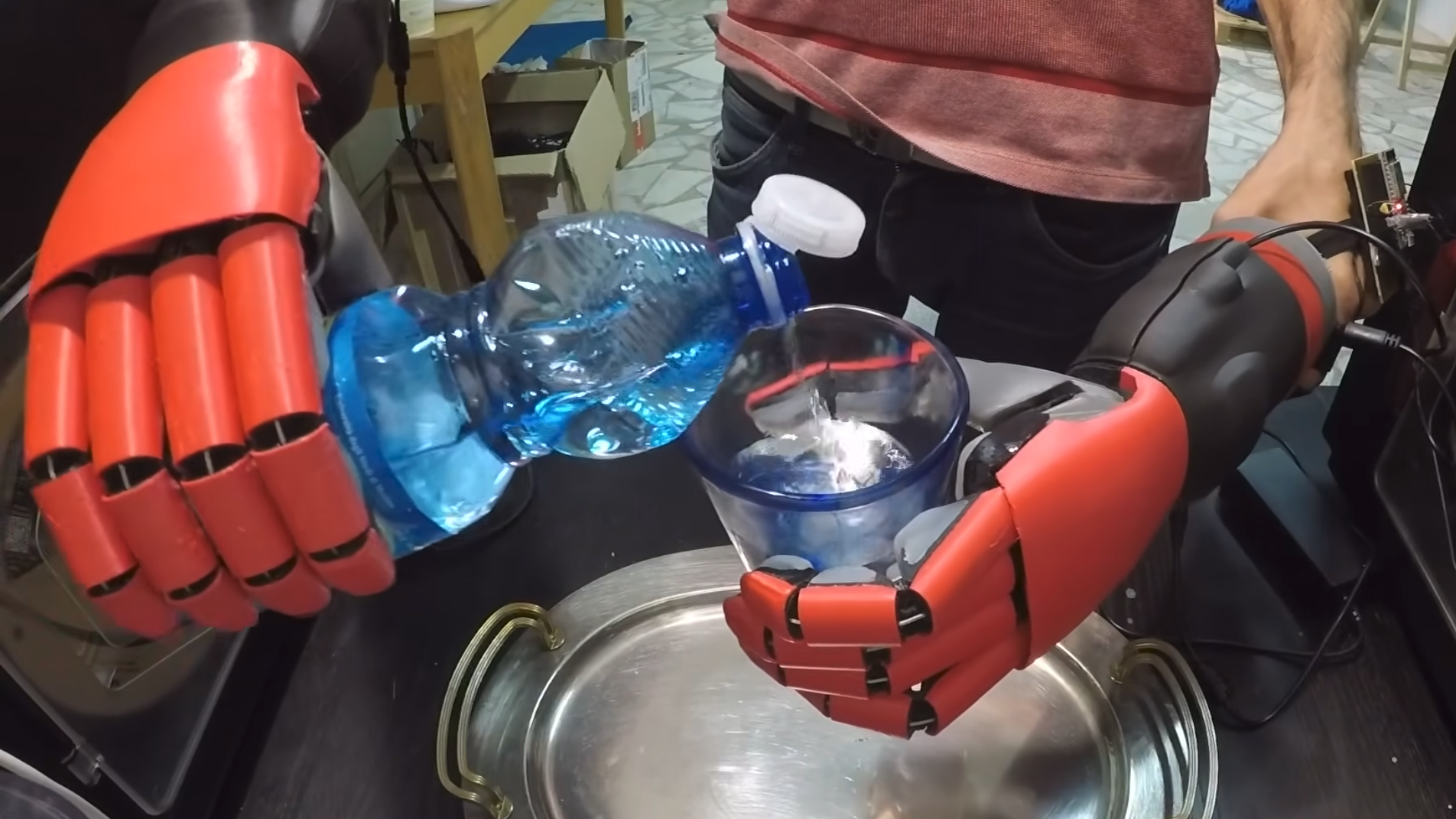
Vittorio Lumare has developed the Yeah Hand, a low-cost, mostly 3D-printed dexterous robot hand actuated by five servo motors per hand using fishing-line tendons similar to human hand mechanics. The hand can lift up to 8 kilograms, apply 5 kg of grasping force, and comes in robotic and experimental prosthetic versions, with the robotic version featuring ROS driver support and multiple mounting flanges.

Researchers at the University of Toronto have developed a monopedal hopping robot that combines quadcopter propulsion with a spring-loaded single leg featuring a compliant, pivoting foot pad. The design allows the robot to maintain stability and traction across diverse terrains including sand and ice, improving upon earlier spike-based designs that proved unreliable.
Dots by OpenAI are a proactive assistant that can keep working across complex projects and everyday tasks. Learn how dots help you stay in control while work moves forward.
Researchers at EPFL and NYU have developed ScaFi, a scalable fish-inspired robot that maintains swimming ability across different sizes by adjusting only the tail rod diameter while keeping the motor and tendon system constant. The team built and tested three versions ranging from 0.6 to 2.9 meters long, demonstrating that the fish-like swimming gait is preserved across a nearly fivefold scale increase, though energy efficiency scaling remains challenging.
Intrinsic, Google's AI robotics group, has open-sourced Intrinsic Core, a ROS-compatible platform providing hardware-agnostic capabilities for building robotic applications including real-time control, pose estimation, motion planning, grasp planning, and simulation services. The company also released Open Machine Tending Solution (OMTS), a reference design for industrial robotic tasks to help developers customize solutions without building from scratch.

This week brought three major AI security failures from industry leaders — Meta's Muse vulnerability, Microsoft's EvilTokens disruption, and concerning gaps in enterprise deployment. The pattern reveals something troubling: companies are shipping AI products faster than they can secure them.
Google introduced Gemini 3.8 Live with Live Avatar, a conversational AI feature that combines real-time video generation with speech synthesis to create virtual avatars with natural lip-syncing, expressions, and multilingual support across 97 languages. The feature is designed for enterprise applications like customer service and interactive walkthroughs, with capabilities for asynchronous tool execution and custom avatar creation while incorporating SynthID watermarking for transparency and safety.
Ringg has developed AI agents powered by OpenAI's GPT-5.6 that can autonomously resolve up to 65% of customer service calls across multiple channels (voice, chat, WhatsApp, web). The solution operates at 90% lower cost compared to using GPT-4.1, and supports multilingual interactions for enterprise customer support automation.
IROS 2026, the IEEE/RSJ International Conference on Intelligent Robots and Systems, will be held September 27 - October 1 in Pittsburgh, featuring keynote talks from leading researchers covering topics including autonomous surgery, soft robotics, embodied AI, manipulation systems, and disaster robotics. The conference program includes 86 workshops and tutorials, plenary panels on startups, space robotics, and generalist vs. specialist robots, and community forums on government funding, robotics education, and foundational research.
Google has launched Gemini 3.8 Flash TTS and Gemini 3.8 Flash-Lite TTS, new text-to-speech models that enable users to create custom, expressive voices from natural language prompts for applications like audiobooks, podcasts, and voice agents. The models support voice generation across 100+ languages, voice replication from audio samples, and granular control over emotional tone, pacing, and dialect, with built-in safety features like watermarking.
MentalHealthBench is a new benchmark designed to evaluate AI systems' ability to provide helpful and safe responses in mental health conversations. The benchmark is informed by expert input and addresses a critical need for standardized evaluation of AI safety and helpfulness in sensitive mental health domains.
OpenAI and Grab launch GO Forward with AI, a regional programme helping 30,000 partners build practical AI skills across Southeast Asia.

Microsoft disrupted EvilTokens, a subscription-based scam platform that used an AI chatbot to compromise 12,000 accounts across 10,000 organizations worldwide. The platform automated business email compromise attacks by using AI to analyze victim inboxes, identify high-value targets, and draft convincing fraud messages, while exploiting OAuth device code authentication to gain account access.

Amazon-Stanford, Carnegie Mellon hosting IROS, Princeton's robotics breakthroughs — academic institutions are suddenly everywhere in robotics and AI news. While tech companies race to deploy products, universities are quietly becoming the connective tissue holding the entire field together.
Pittsburgh will host the 2026 IEEE/RSJ International Conference on Intelligent Robots and Systems (IROS) from September 27 through October 3 at the David L. Lawrence Convention Center, highlighting Carnegie Mellon's leadership in robotics research and development.
OpenAI has outlined a proposal for developing shared global AI standards, emphasizing the need for coordinated evaluation, reporting, and governance frameworks to improve AI safety. The initiative addresses concerns about standardizing how AI systems are assessed and regulated across different jurisdictions.