

The electric scooter rental company Lime has filed for IPO
The startup has expanded to more than 230 cities across the world, but has yet to become profitable.
Latest news and articles about startups

The startup has expanded to more than 230 cities across the world, but has yet to become profitable.

While humanoid robots and AI agents dominate headlines, a quieter revolution is happening in battery technology. Nyobolt's $60M raise signals that fast charging — not computing power or dexterity — may determine which robots actually make it out of the lab.
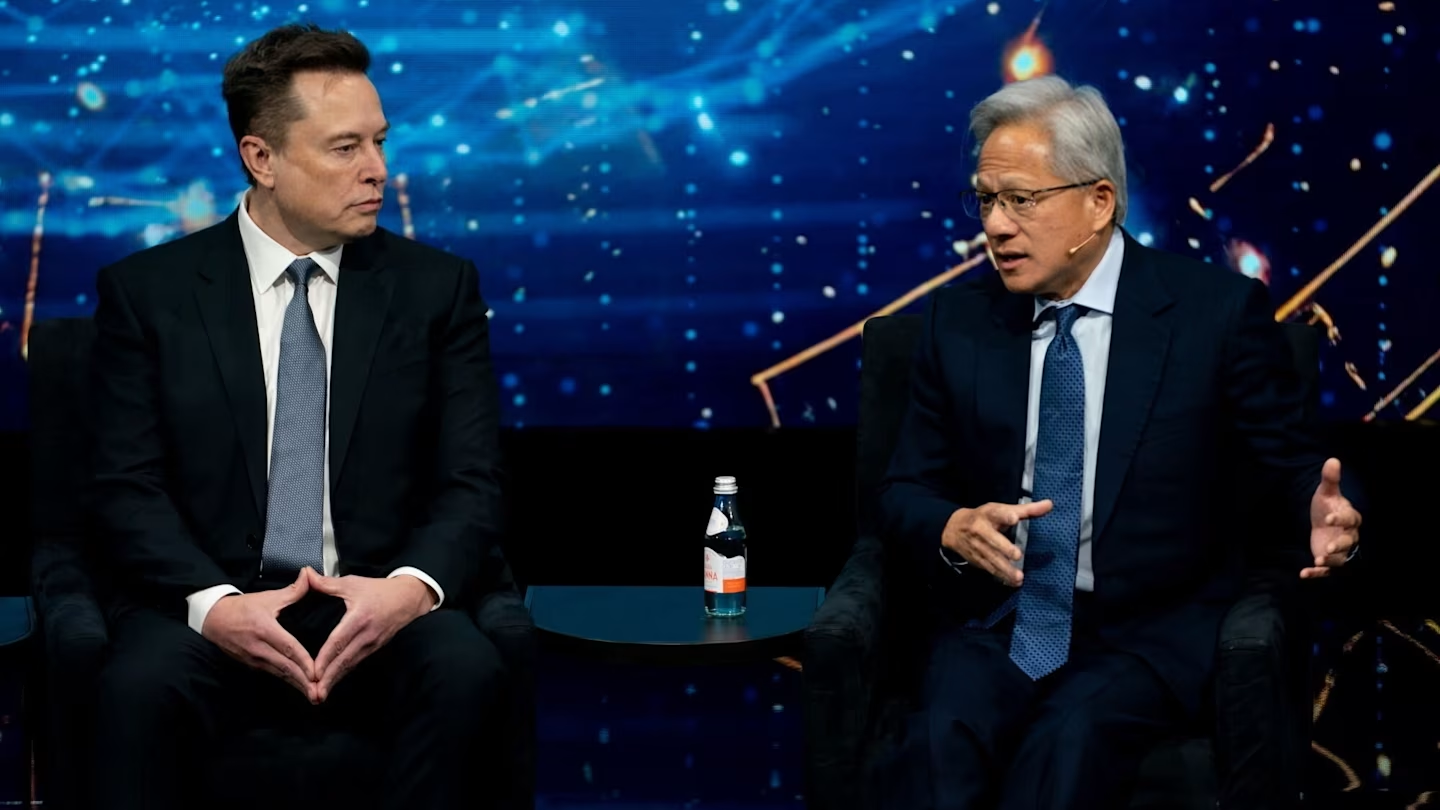
In the second week of the landmark trial between Elon Musk and OpenAI, Musk's motivations for bringing the suit were under scrutiny. Last week, Musk took the stand, alleging that OpenAI CEO Sam Altman...
Eric Chan, Chief Scientist at Rhoda AI, discusses how Direct Video Action (DVA) models trained on internet video data are replacing traditional robotics data collection methods. The approach enables robots to learn complex tasks with minimal training data and supports zero-shot learning capabilities for real-world deployment.
Nyobolt, a Cambridge-based fast-charging battery company, has raised $60 million in funding at a $1 billion+ valuation to accelerate deployment of its power systems for autonomous mobile robots and physical AI applications. The company's batteries deliver significantly improved performance for warehouse robots and autonomous systems, with Symbotic leading the investment round and deploying Nyobolt's technology in its SymBot AMRs for 24/7 warehouse operations.
Two new approaches to robot training reveal a fundamental split in AI robotics: Genesis AI betting on human-shaped hands and simulation, while Tutor Intelligence deploys 100 real robots with remote human tutors. The answer to which path works better may define the next decade of robotics.
Hugging Face launched an agentic toolkit for Reachy Mini, an open-source desktop robot, that enables users to build applications without coding by describing desired behaviors in plain English while an AI agent writes and deploys the code. The toolkit dramatically lowers barriers to robotics development by removing the need for technical expertise, expensive hardware, and lengthy integration work, with Hugging Face's app store now offering over 200 community-built applications ranging from voice-controlled facilitators to chess-playing companions.
After decades of false starts with social robots, a new wave of startups is betting that emotionally intelligent companions can finally find a place in our homes. But this time, they're learning from past failures—and building very different machines.
Colin Angle, co-founder of iRobot, has launched Familiar Machines & Magic, a startup developing consumer companion robots called Familiars designed to form emotionally intelligent, long-term relationships with users. The company, which emerged from stealth, combines Angle's 30+ years of consumer robotics experience with a team including veterans from iRobot, Amazon, Disney Research, MIT, and Boston Dynamics to build a platform for artificial life.
Brightpick CEO Jan Zizka will present at the Robotics Summit & Expo on May 27-28 in Boston, outlining a practical roadmap toward fully automated lights-out warehouse operations. The talk will address how hybrid human-robot systems are making incremental progress toward autonomous warehouses, where robots handle repetitive tasks while humans manage exceptions, with discussion of the technical and economic challenges of automating the final workflow edge cases.
Parloa, a Berlin-based startup, has built an AI Agent Management Platform (AMP) that uses OpenAI models to help enterprises design, deploy, and manage voice-driven customer service agents without coding. The platform allows non-technical teams to define agent behavior in natural language, simulate conversations with AI models before deployment, and continuously evaluate performance in production environments.
From Wonder's AI-generated restaurants to Genesis AI's piano-playing hands, the robotics industry is racing to automate cooking and food service. But this surge in culinary automation reveals less about consumer demand and more about where the real money in robotics lies — and it's not in your kitchen.
Genesis AI, a Khosla-backed startup that raised $105M for foundational AI in robotics, unveiled its GENE-26.5 model along with a human-hand-shaped robotic hand it designed in-house. The startup developed a sensor-loaded data collection glove and uses simulation to accelerate model training, aiming to bridge the embodiment gap in robotics by collecting human manipulation data to train robots for complex tasks like cooking, lab work, and other real-world applications.
Genesis AI unveiled GENE-26.5, an AI foundation model designed for dexterous robotic manipulation that enables robots to perform complex, human-level tasks like cooking, lab work, and piano playing. The company also introduced a proprietary robotic hand that mirrors human anatomy and a data-collection system with tactile sensing to enable direct skill transfer from humans to robots, addressing a fundamental bottleneck in training robotics foundation models.
Marc Lore's Wonder is using AI to automate restaurant creation and operations, enabling anyone to launch a restaurant brand in under a minute through an AI-powered platform that generates menus, branding, and recipes. The company operates 120 programmable kitchen locations with robotic cooking equipment like conveyor systems and robotic arms, and recently acquired Spice Robotics to further automate food preparation, with plans to scale to 400 locations by next year.
WaiV Robotics emerged from stealth with a $7.5 million seed-funded autonomous landing platform designed to enable drones to safely take off and land from moving ships at sea. The system uses a patent-pending catch-lock-release mechanism combined with AI-driven predictive algorithms to handle the challenges of maritime drone operations, working with any drone without requiring hardware or software modifications.
Tutor Intelligence has built DF1, a Data Factory featuring 100 bimanual robotic manipulators trained by remote human tutors to develop its Ti0 vision-language-action model for real-world robot learning. The MIT-CSAIL-founded startup raised $34 million in Series A funding in December 2025 and claims DF1 is the largest robotic data factory in the U.S., using proprioceptive teleoperation and velocity normalization techniques to train generally capable robot AI at scale.

While headlines obsess over humanoid robots in factories, a quieter revolution is happening in logistics hubs. From Tokyo's baggage handlers to California's autonomous trucks, the unglamorous work of moving stuff from point A to point B is where robotics is actually proving its commercial viability.
Colin Angle, founder of iRobot, launched a new startup called Familiar Machines & Magic with a companion robot designed to perform "emotional work" and reduce loneliness through physical presence and interaction. The robot, called a "familiar," is a small quadruped with 23 degrees of freedom, fuzzy exterior, edge AI processing, and communicates through motion and behavior rather than screens or speech, aiming to integrate into daily life in ways existing companion robots have failed to achieve.
Ouster announced Rev8, a new family of lidar sensors featuring patented native-color lidar technology that combines 3D structural data with color vision in a single sensor. The sensors are powered by Ouster's L4 Silicon architecture and offer double the range and resolution of previous generations, positioning them for autonomous systems and industrial applications requiring advanced 3D perception.

Meta's acquisition of robotics startup ARI and its push into humanoid development reveals a troubling shift: the future of general-purpose robots is being written in Silicon Valley boardrooms, not robotics labs. As tech giants race to control the humanoid market, smaller innovators face a stark choice—get bought or get left behind.

Meta has acquired Assured Robot Intelligence (ARI), a robotics AI startup, to advance its humanoid robot development efforts. ARI's expertise in designing AI models for robot control and whole-body humanoid systems will be integrated into Meta's Superintelligence Labs, with the startup's founders joining Meta's team to build general-purpose physical agents trained on human experience.
FAULHABER released its DualGear drive system, a compact dual-motor solution designed for autonomous logistics and conveyor belt applications in space-constrained intralogistics environments. The system combines a brushless BX4 motor with dual GPT planetary gearheads to enable two synchronized movements from a single drive unit, reducing integration effort and system costs while maintaining high performance and control accuracy.
The Robot Report Podcast episode discusses how robotics and AI startups can navigate enterprise adoption, featuring insights from Silicon Foundry's CEO Neal Hansch. The episode also covers news including the 2026 Engelberger Robotics Awards honoring industry leaders, Flex and Teradyne's expanded partnership to deploy collaborative robots and AMRs for physical AI scale, and Figure AI's significant production milestone of achieving 24x throughput increase to one humanoid robot per hour at its BotQ facility.
In the first week of the landmark trial between Elon Musk and OpenAI, Musk took the stand in a crisp black suit and tie and argued that OpenAI CEO Sam Altman and president Greg Brockman had deceived h...
This article is a roundup of the top 10 robotics stories from April 2026, covering major developments including Tesla's plans to manufacture 10 million Optimus humanoid robots, Pudu Robotics' $150M funding round, Locus Robotics' autonomous fulfillment system, ABB's new collaborative robot family, and Generalist AI's GEN-1 general-purpose model achieving 99% task success rates. The month saw significant technical milestones, large funding rounds, and industry consolidation across humanoid robotics, industrial automation, and AI-powered systems.
The Download newsletter covers two AI-related stories: Goodfire's Silico tool uses mechanistic interpretability to let researchers debug and adjust LLM parameters during training, aiming to make AI development more scientific and controllable; and China's AI labs are releasing open-weight models that developers can download and run locally, challenging Silicon Valley's closed API model and making AI development more decentralized.
Orpheus Ocean, a spinoff from Woods Hole Oceanographic Institution, is deploying low-cost autonomous underwater vehicles (AUVs) designed for deep-sea exploration and sediment sampling at depths up to 11,000 meters. The submersibles, built for a couple hundred thousand dollars compared to $5-10 million for existing alternatives, are conducting their largest operational test by mapping the Pacific seafloor for critical mineral deposits while collecting sediment cores and high-resolution imagery.
Teradyne Robotics reported $91 million in Q1 2026 revenue, marking its fourth consecutive quarter of growth, with strength in e-commerce, electronics manufacturing, and semiconductor end markets including AI data centers. The company's robotics division, which includes Universal Robots cobots and Mobile Industrial Robots, saw AI revenue reach approximately 15% of quarterly sales, and the company is leveraging robotic-assisted assembly and data center operations as part of its wafer-to-AI strategy.
A new US-wide cell phone network marketed to Christians is set to launch next week. It blocks porn, which experts in network security say marks the first time a US cell plan has used network-level blo...
The ultimate plan to live forever is a brand new body. This subscriber-only eBook explores R3 Bio, a small startup that has pitched a startling and ethically charged vision for "brainless clones" to s...
Launchpad Build AI announced the launch of its Manufacturing Language Model (MLM), a specialized AI system designed to accelerate industrial automation design by up to 50% and lower barriers to robot adoption for manufacturers of all sizes. The company, which rebranded from Launchpad and raised $11 million in Series A funding, has established U.S. headquarters in California and appointed new senior technical leadership to support its growth in assembly automation.
Goodfire, a San Francisco startup, released Silico, a mechanistic interpretability tool that allows researchers to examine and adjust AI model parameters during training for more precise control over model behavior. The tool uses AI agents to automate interpretability work that was previously done manually, enabling developers to debug LLMs by mapping neurons and tracing pathways to understand and reduce unwanted behaviors like hallucinations.

Meta CEO Mark Zuckerberg announced that the company's superintelligence team is developing AI agents for personal and business use, built on the newly-released Muse Spark model from Meta Superintelligence Labs. Zuckerberg emphasized Meta's goal is to make these agents more accessible and user-friendly than existing platforms like OpenClaw, though no timeline was provided for their release.

After years of flashy demos and PR stunts, food service automation is finally getting serious. Two recent acquisitions signal a shift from novelty to necessity—and it's happening in the back of house, where nobody's watching.
Apptronik has hired Daniel Chu, former chief product officer at Waymo, as its new CPO to lead the commercialization of its Apollo humanoid robot platform. The move signals the Austin-based startup's transition from R&D to mass-market deployment, backed by a $935 million Series A and plans to deploy general-purpose robots across industrial, healthcare, and eldercare applications.
Appetronix acquired Cibotica, a developer of automated ingredient dispensing and portioning technology, to expand its robotic restaurant operations beyond autonomous pizza kitchens. The acquisition brings Cibotica's Remy automated bowl and salad assembly system to Appetronix's restaurants, enabling the company to offer kitchen automation across multiple cuisines and formats while addressing labor shortages and rising costs in the restaurant industry.
This newsletter roundup covers several major AI developments including Elon Musk's legal battle with OpenAI over the company's for-profit status and potential $134 billion damages claim, the persistent challenge of AI profitability despite hype, and concerning trends around weaponized deepfakes. Additional news includes OpenAI ending its exclusive Microsoft partnership, Google's classified Pentagon AI deal, regulatory actions by the EU, and pricing moves by DeepSeek.
OpenAI and AWS are expanding their strategic partnership to bring OpenAI models (including GPT-5.5), Codex, and Amazon Bedrock Managed Agents to AWS customers. The integration allows enterprises to access OpenAI's frontier models and agentic capabilities within their existing AWS infrastructure, security protocols, and workflows, with all three offerings launching in limited preview.
After a yearslong legal feud, Elon Musk and OpenAI CEO Sam Altman are heading to trial this week in Northern California in a case that could have sweeping consequences. Ahead of OpenAI's highly antici...
SquareMind raised $18 million to commercialize Swan, a robotic platform that uses AI and robotics to automate full-body dermoscopic skin imaging for melanoma detection and tracking. The funding, led by Sonder Capital, will support the company's preparation for U.S. and European market launch, addressing dermatology's capacity constraints and improving clinical documentation efficiency.
The 2026 Robotics Summit & Expo (May 27-28 in Boston) will feature an extensive track dedicated to Physical AI, covering topics including scalable robot systems, data integration, embodied AI, large behavior models, and industrial applications. The event will include keynotes and panel discussions from leading researchers and industry figures such as Russ Tedrake, executives from companies like Brain Corp, Agtonomy, and Universal Robots, and demonstrations of AI-powered robotics integration across retail, logistics, and manufacturing sectors.
Sereact announced a $110 million Series B funding round to scale its Cortex 2.0 robotic brain and expand into the U.S. market with a new Boston office. The company's AI system, trained on real warehouse operations across 200 deployed systems and one billion picks, now includes Cortex 2.0 which uses predictive planning via vision-language-action models and world models to anticipate outcomes before executing robotic tasks in manufacturing and logistics.
Choco, an AI-powered food distribution platform, deployed OpenAI APIs to automate order processing across its supply chain network of 21,000 distributors and 100,000 buyers. The company built AI agents (OrderAgent and VoiceAgent) that process multimodal inputs—emails, SMS, images, voice calls—and convert them into structured ERP-ready orders, achieving 50% reduction in manual order entry and processing 8.8M+ orders annually.
Accenture, Vodafone, and SAP just launched a pilot program putting humanoid robots in a real warehouse. Combined with Pudu Robotics' $150M raise and Ghost Robotics shipping over 1,000 units, we're watching enterprise money flood into physical AI — and that changes everything.
Ghost Robotics, which has shipped over 1,000 legged robots since 2015, will present at the Robotics Summit & Expo in May 2026, with CEO Gavin Kenneally discussing 10 years of deploying quadruped robots in defense, security, and industrial applications. The company recently released a manipulator arm for its Vision 60 robots to expand their manipulation capabilities, and its systems are widely used throughout the Department of Defense.
The legal battles erupting between AI giants reveal a deeper crisis: we still haven't figured out the basic property rights of artificial intelligence. From OpenAI's courtroom drama to xAI's constitutional challenge, the industry is fighting over questions that should have been answered years ago.
The Robot Report Podcast episode features Dr. Jan Liphardt, a Stanford bioengineering professor and founder of OpenMind and OM1, discussing the future of physical AI. The episode covers Tesla's announcement of a large-scale Optimus humanoid factory in Fremont with plans for a second-generation facility in Texas targeting 10 million units annually, a patent infringement case involving Teradyne Robotics and Elite Robots over collaborative robot software, and HII's partnership with Path Robotics and GrayMatter Robotics on a high-yield production robotics program.
Google plans to invest up to $40 billion into AI startup Anthropic, with $10 billion upfront and $30 billion contingent on performance milestones, alongside a commitment to provide 5 gigawatts of computing capacity using Google's TPU infrastructure. This investment follows a similar $25 billion deal Anthropic announced with Amazon in April, exemplifying the circular investment and partnership patterns common in the competitive AI industry.
SS Innovations unveiled four in-development surgical robotic systems including the SSi Vimana Aero drone-deployed surgical platform for battlefield medicine, the SSi Avtara humanoid surgical robot with AI and teleoperation capabilities, and the SSi Operion mobile operating room. The company aims to make robotic surgery more affordable and accessible across military, healthcare, disaster response, and industrial applications.