

Maker Culture Just Became Robot R&D
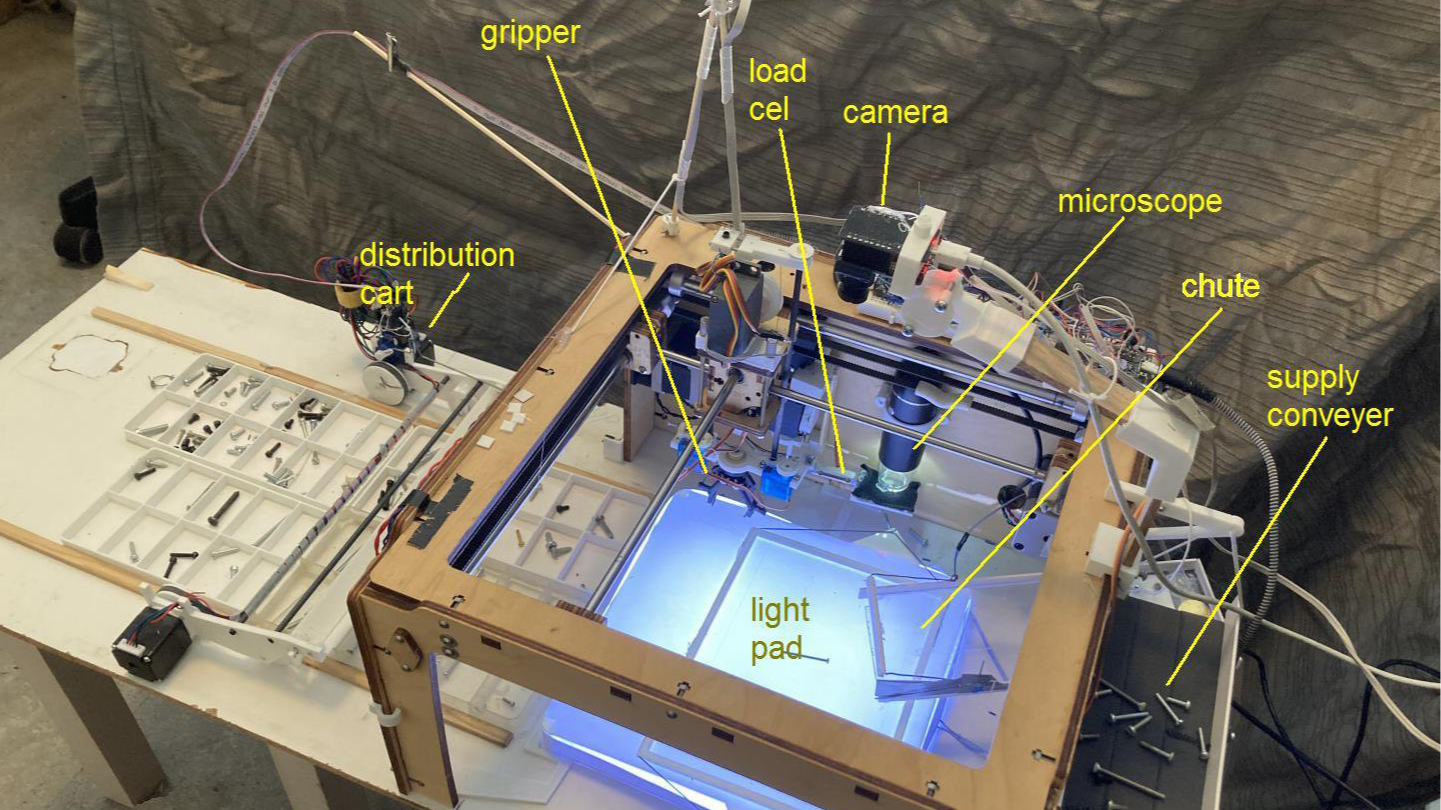
There's a peculiar artifact buried in this week's robotics news that deserves more attention than it's getting. Between announcements of $250 million funding rounds and Navy shipbuilding contracts sits a story about someone who built an automated bolt sorter using salvaged 3D printer parts and an ESP32 camera module. It's easy to dismiss as hobbyist tinkering. That would be a mistake.
The distance between a garage project and a production system has never been smaller. That bolt sorter — built as a proof-of-concept for object detection, gripping, and sorting — uses the same fundamental technologies that companies are now deploying at scale: machine vision, coordinated motion control, and intelligent decision-making. The difference isn't capability anymore. It's polish, reliability, and capital.
Consider the VANTIX cycloidal gearbox, another maker project from recent news. It's a compact, 3D-printed precision drive mechanism designed for standard stepper motors. Cycloidal drives are hardly new — they're used in industrial robotics for their high torque density and precision. But this version can be printed at home for a few dollars in materials. The knowledge barrier that once protected industrial robotics suppliers has been breached by accessible manufacturing and open-source sharing.
This democratization has consequences beyond cheaper hobby robots. When Tacta Systems announced its dexterous robotic hand with fluidic tendon actuation, they introduced it alongside a data-capture glove that lets robots learn from human demonstration. That's not dissimilar in principle to what the maker community has been doing for years — breaking down complex tasks into learnable components and sharing the results. The difference is primarily in sophistication and funding, not in fundamental approach.
The maker-to-market pipeline is compressing. Nomagic's deployment of physical AI in warehouses, Avatar Robotics' semi-humanoid systems, even the specialized robots that Path Robotics and GrayMatter are installing in shipyards — all of these rely on components and software frameworks that didn't exist a decade ago but are now accessible to anyone with initiative and an internet connection. ROS, computer vision libraries, affordable sensors, machine learning frameworks — the toolchain of professional robotics is largely the same one available to dedicated hobbyists.
What we're witnessing isn't just hobbyists getting better tools. It's the collapse of the moat that separated experimentation from commercialization. When a maker can prototype a vision-guided sorting system in their garage using commodity components, and when that same maker can access the same learning resources, simulation tools, and component suppliers as funded startups, the traditional innovation hierarchy gets flipped.
This matters because innovation doesn't always come from the expected places. The Chernobyl cleanup required rapid deployment of specialized robots under impossible conditions — essentially a crisis-driven hackathon that produced working systems in weeks. Today's maker community operates in a similar mode of rapid iteration and creative problem-solving, constrained by budget rather than radiation but equally inventive.
The robotics industry is still organized around the assumption that serious development requires serious capital. But as the tools democratize and the knowledge spreads, that assumption is looking increasingly outdated. The next breakthrough in robotic manipulation or autonomous navigation might not come from a university lab or a well-funded startup. It might come from someone who just wanted to sort their hardware drawer more efficiently and stumbled onto something bigger.
That bolt sorter might never leave the garage. Or it might be the seed of something that changes how we think about small-scale automation. Either way, the fact that it exists at all tells us something important about where robotics is heading — and who gets to shape that future.