
Nobody Told the Robots They Were Supposed to Collaborate
The AI headlines this week were dominated by text-to-speech models, custom voice generation, and virtual avatars with convincing lip-syncing. Meanwhile, in a Carnegie Mellon lab, researchers achieved something far less flashy but infinitely more consequential: they taught multiple robots to coordinate their movements to navigate cluttered warehouses together.
The contrast is instructive. While consumer-facing AI focuses on individual interaction—one user, one chatbot, one voice—the robotics field is grappling with a fundamentally different challenge. LAMP, Carnegie Mellon's Long-Horizon Adaptive Manipulation Planning system, doesn't just make one robot smarter. It creates a framework where multiple robots can share the cognitive load of understanding their environment and coordinating complex physical tasks.
This matters because the real world doesn't care about your conversational AI's charm. A warehouse doesn't need robots that can banter in 97 languages. It needs robots that can collectively figure out how to move a pallet through a crowded aisle without getting stuck, recalculating their approach when another robot blocks the path, and adapting when inventory gets rearranged overnight.
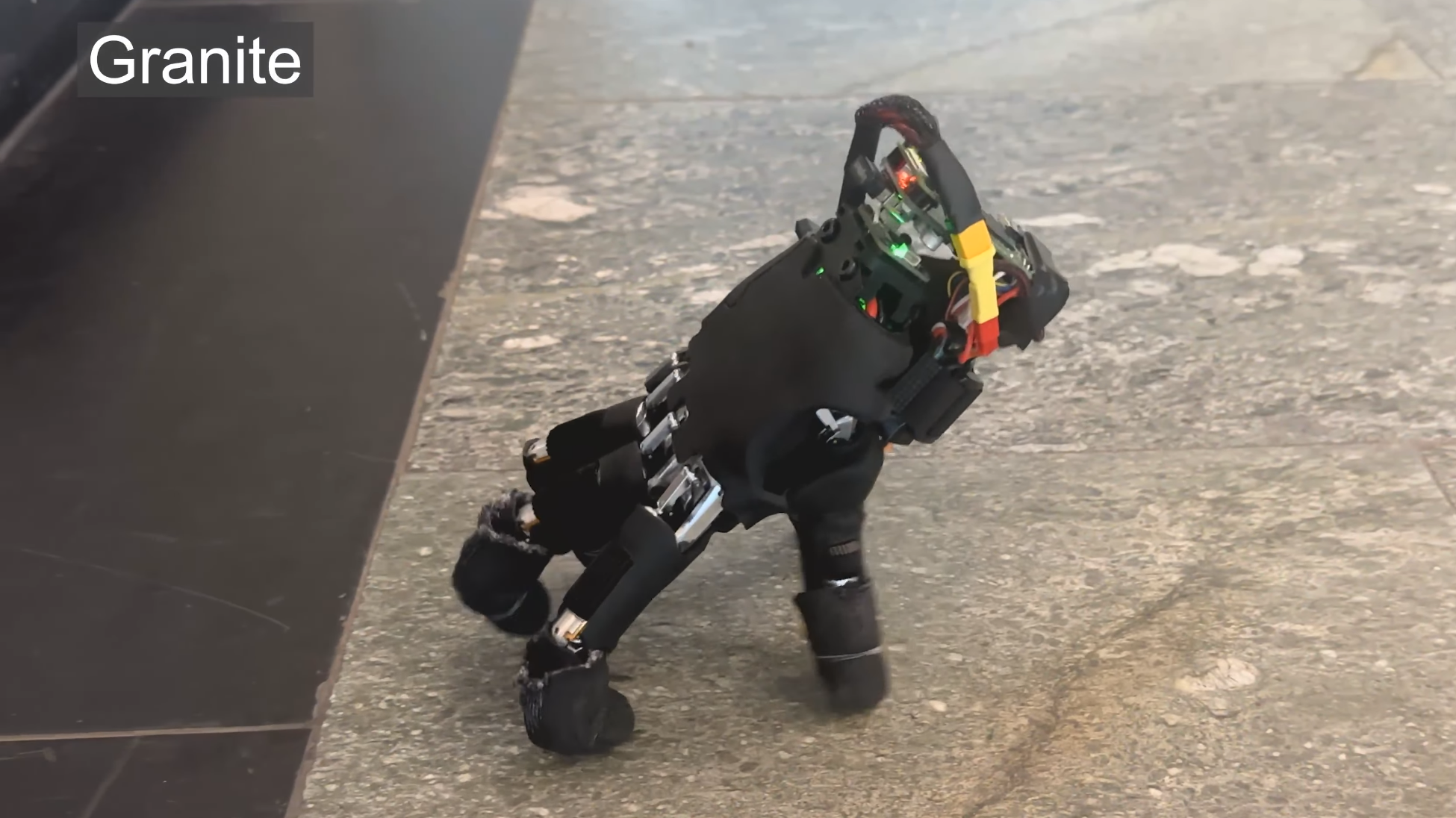
The walking robotic hand from ETH Zurich reinforces this pattern. Yes, it's bizarre to watch fingers locomote across terrain like some escaped Thing from The Addams Family. But look past the spectacle: this is research into resilient, adaptive physical systems that can recover from failures and operate in unpredictable conditions. The hand doesn't just walk—it falls, gets back up, and keeps going. That's not a party trick. That's the kind of robust autonomy that actual deployment requires.
What's fascinating is how disconnected these research trajectories are from the AI product releases dominating tech news. Google and OpenAI are iterating on text-to-speech quality and conversational interfaces. Important work, certainly. But Carnegie Mellon and ETH Zurich are solving problems that sit between hardware and software, between individual agents and collective systems, between laboratory conditions and messy reality.
The industry's obsession with making AI more human-like—more expressive voices, more natural conversations, more convincing avatars—misses the point of what automation actually needs to deliver. A robot doesn't need to convince you it has feelings. It needs to coordinate with three other robots to move a shipping container without human intervention.
This isn't an argument against conversational AI development. It's an observation about where the truly difficult problems live. Multi-robot coordination requires solving simultaneous localization and mapping, dynamic path planning, failure recovery, and real-time negotiation between agents—all in physical space where mistakes have consequences beyond a bad chatbot response.
The gap between these research domains suggests we're building two separate futures. One where AI gets better at talking to humans individually. Another where robots get better at working together without us. Both matter. But only one of them can actually move the boxes.