

Simulation Just Became Robotics' Most Valuable Real Estate
Something curious is happening in robotics labs and startups around the world: the physical robots are sitting idle while the real work happens in simulation.
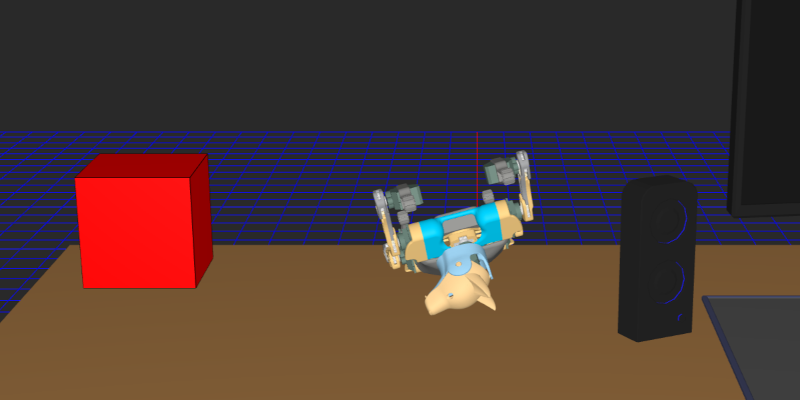
Three separate developments this week illuminate a trend that's been building quietly for years. Hackaday featured a browser-based simulator for the OpenCat robot dog that lets anyone experiment with quadruped programming for free. Meanwhile, an industry analysis highlighted how "virtual gyms"—comprehensive simulation environments combining digital twins, reinforcement learning, and sensor modeling—are becoming essential infrastructure before any real-world deployment. And researchers at Amazon and University of Michigan unveiled HydroShear, a physics-based simulator that teaches robots tactile manipulation entirely in virtual space before transferring to hardware.
The pattern is unmistakable: simulation has evolved from a nice-to-have development tool into the foundation of modern robotics.
This represents a profound shift in capital allocation and risk management. Traditional robotics development meant expensive hardware prototypes, costly failures, and slow iteration cycles. Every test required physical space, safety protocols, and the very real possibility of damaging equipment worth tens of thousands of dollars. Now, companies can run thousands of training scenarios overnight, fail catastrophically without consequence, and iterate at software speed rather than hardware speed.
The economics are compelling. A browser-based simulator costs effectively nothing to distribute and scale. A virtual gym can train a robot through scenarios that would be dangerous, expensive, or simply impractical in the real world. HydroShear enables robots to master dexterous manipulation through millions of simulated interactions that would take decades to accumulate physically.
But there's a deeper transformation at work. The "sim-to-real gap"—the difference between simulated performance and real-world results—has historically been robotics' dirty secret. Robots that performed flawlessly in simulation would stumble in actual deployment. Yet as these recent developments show, the industry isn't trying to eliminate this gap anymore. Instead, they're systematically engineering it away through better physics modeling, more accurate sensor simulation, and smarter transfer learning techniques.
Path Robotics' use of AI-driven vision guidance for welding optimization, mentioned in another recent article, demonstrates how this plays out commercially. The company can test countless welding parameters and scenarios in simulation before ever striking an arc on real metal. The result is robots that arrive at deployment sites already trained for the specific challenges they'll face.
The accessibility angle matters too. That browser-based robot dog simulator isn't just a cute demo—it's democratizing robotics education and experimentation. When anyone with a web browser can program a quadruped robot, you're lowering barriers to entry in a field that has traditionally required significant capital investment. The next breakthrough in legged locomotion might come from a teenager in rural India rather than a well-funded lab in Boston.
There's an irony here worth noting: as robots become more physical, more dexterous, and more present in our world, their development is becoming increasingly virtual. The path to better real-world robots runs directly through better simulations.
For robotics companies, the message is clear. Investment in simulation infrastructure isn't auxiliary to robot development—it is robot development. The winners in this space will be those who recognize that their most valuable real estate isn't factory floor space, but the fidelity and sophistication of their virtual environments. In robotics, the future is being built in places that don't physically exist.