
Tactile Sensing Is Finally Having Its Moment
For years, robotics has been locked in a vision arms race. Every new demo showcases better object recognition, more sophisticated scene understanding, increasingly clever camera arrays. Meanwhile, the sense that humans rely on for virtually every manipulation task — touch — has been treated like a nice-to-have feature.
That's starting to look like a costly oversight.
Two developments this week highlight a sudden convergence of interest in tactile sensing. Amazon and the University of Michigan unveiled HydroShear, a physics-based simulator that teaches robots to understand tactile forces for complex manipulation. Separately, MIT engineers demonstrated an ultrasound wristband that tracks hand movements by imaging wrist muscles and tendons, enabling precise wireless control of robotic hands. These aren't incremental improvements to existing vision systems — they represent a fundamental shift in how we're thinking about robot perception.
The timing isn't coincidental. As robots move from controlled factory floors into messier real-world applications, vision alone keeps hitting walls. You can teach a robot to recognize a coffee cup with near-perfect accuracy, but that doesn't help it understand whether the cup is empty, full, made of paper, or scalding hot. Touch provides the contextual information that vision simply can't capture.
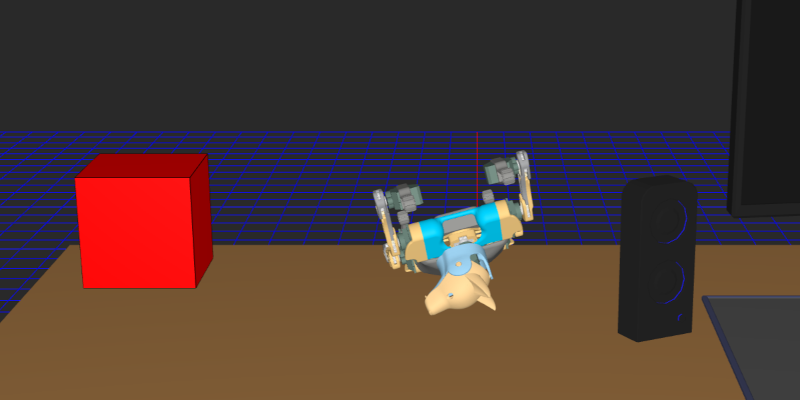
What makes the Amazon-Michigan research particularly significant is its focus on simulation. HydroShear enables robots to learn dexterous manipulation entirely virtually, then transfer those skills to the real world. This matters because tactile data is notoriously difficult to collect at scale — you can't just scrape millions of images from the internet. By creating realistic physics simulations of how materials compress, slide, and deform under pressure, researchers can generate the massive training datasets that modern machine learning demands.
The MIT wristband takes a different but complementary approach. Rather than trying to embed sensors in robot fingers (which creates durability and calibration nightmares), it reads human intention through muscle activity. This elegantly sidesteps the sensor integration problem while providing remarkably precise control. The wearer's natural proprioception does the heavy lifting.
Both systems hint at where robotics is actually headed: away from the humanoid form factor obsession and toward hybrid approaches that combine the best of biological and mechanical sensing. We don't need robots with human-like fingertips if we can give them superhuman understanding of forces and materials through simulation and indirect sensing.
The broader implication is that robotics is entering a new phase where the bottleneck isn't mechanical capability or computing power — it's sensory understanding. Boston Dynamics proved a decade ago that robots can move with remarkable agility. What they still can't do reliably is interact with the infinite variety of objects, textures, and materials they encounter in unstructured environments.
Touch might be the unsexy sense, but it's turning out to be the essential one. The companies and research labs that crack tactile sensing at scale won't just have better robots — they'll have robots that can finally do the manipulation tasks that actually matter in logistics, manufacturing, and home environments.
Vision made robots smart about what they're looking at. Touch will make them competent at what they're actually doing.