
Touch Changes Everything for Humanoid Robots
We've spent years watching humanoid robots learn to walk, run, and even do backflips. Companies demonstrate increasingly sophisticated mobility, and AI models give robots the ability to understand and respond to verbal commands. Yet despite all this progress, most humanoid robots still interact with the physical world like they're wearing oven mitts in the dark.
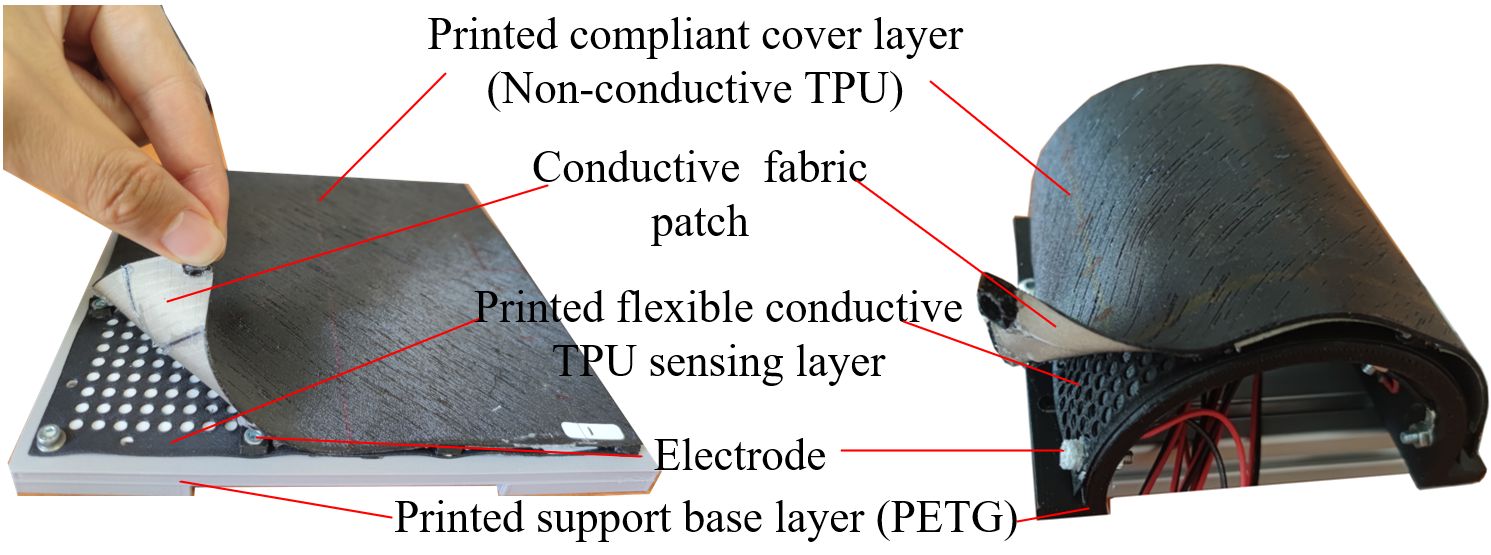
That's why the recent development of 3D-printed artificial skin using electrical impedance tomography deserves more attention than it's getting. The technology, which uses just 16 electrodes embedded in flexible TPU material to accurately detect touch location and pressure, represents a fundamental shift in how robots might interact with their environment.
Consider what touch sensitivity actually enables. A warehouse robot that can feel when it's gripping a package too hard or too soft. A healthcare assistant that can detect the difference between firm support and uncomfortable pressure. A manufacturing robot that can sense when a part isn't quite aligned, even if the visual system hasn't caught the discrepancy. These aren't flashy capabilities, but they're essential for robots operating in unstructured, human-centric environments.
The timing matters too. We're seeing an unprecedented push toward deploying humanoid robots in commercial settings. Multiple companies have announced plans to place humanoids in warehouses, factories, and retail environments within the next few years. But there's a credibility gap between what these robots can do in controlled demonstrations and what they'll need to handle in messy reality. Reliable tactile feedback is part of closing that gap.
What makes this particular approach notable is its practicality. Using only 16 electrodes keeps the system relatively simple and presumably more affordable to manufacture at scale. The 3D-printing approach means the skin can be customized for different robot form factors and applications. These aren't theoretical advantages—they're the kind of engineering details that determine whether a technology stays in the lab or makes it into production robots.
The broader robotics industry has focused heavily on perception through cameras and lidar, and on cognition through increasingly capable AI models. Both are important. But robots also need proprioception—the ability to sense their own state and interaction with the world through touch and force feedback. It's the difference between a robot that can see a door handle and one that can actually feel when it's successfully grasped it.
This development also highlights a pattern worth watching: some of the most important robotics breakthroughs are happening in areas that don't generate viral videos. Artificial skin doesn't demo as well as a robot doing parkour. But for robots that need to actually accomplish useful work rather than impressive stunts, touch sensitivity might matter more than perfect balance.
The question now is how quickly this kind of technology makes its way from research papers into commercial products. The gap between a laboratory demonstration and a reliable, manufacturable component can be years. But the fact that researchers are focusing on practical constraints like electrode count and 3D-printability suggests they're thinking about that transition.
Robots have gotten remarkably good at moving and talking. Now they're starting to learn how to feel. That might be the breakthrough that finally makes them useful.