

Virtual Testing Grounds Are Where Robots Actually Grow Up
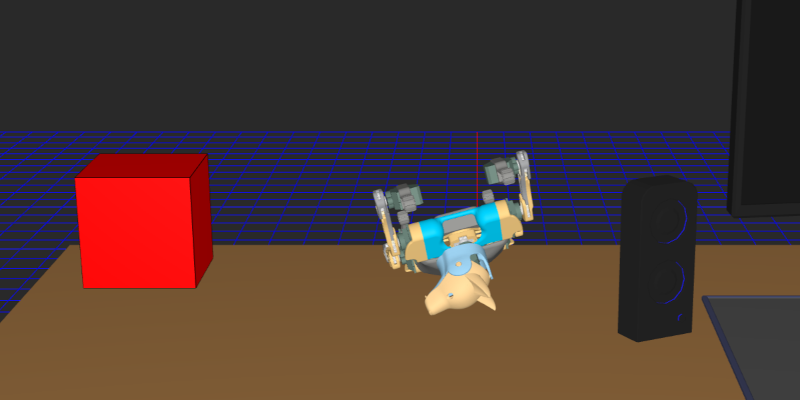
There's a pattern emerging in robotics development that's easy to miss if you're focused on the flashy hardware announcements. While everyone watches humanoid robots stumble through warehouse demos, the most consequential work is happening in entirely virtual spaces where failure costs nothing and iteration happens at digital speed.
Consider the breadth of simulation work making headlines this week. Hackaday highlighted a browser-based simulator for the OpenCat robot dog, making quadruped programming accessible to anyone with an internet connection. Amazon and University of Michigan unveiled HydroShear, a physics-based simulator teaching robots to understand tactile forces for manipulation tasks. Meanwhile, industry analysis emphasizes how 'virtual gyms' combining digital twins, reinforcement learning, and sensor modeling have become essential infrastructure before any real-world deployment.
This isn't just about making development cheaper or safer—though it certainly does both. What we're witnessing is the democratization of robotics expertise and a fundamental rewiring of the development pipeline. When a complex robot simulator runs in a web browser, the barrier to entry collapses. When researchers can train manipulation policies entirely in simulation and transfer them to real hardware, the traditional build-test-rebuild cycle gets replaced with something far more sophisticated.
The implications extend beyond faster development timelines. Virtual environments allow robots to fail millions of times in ways that would be impossible, dangerous, or prohibitively expensive in the physical world. A simulated robot can practice welding on a digital ship, attempt surgical procedures on virtual patients, or navigate environments that don't yet exist. The sim-to-real gap—the difference between simulated and actual performance—remains a technical challenge, but it's increasingly treated as a known variable to be managed rather than an insurmountable barrier.
What makes this shift particularly significant is how it changes who can participate in robotics development. Browser-based simulators and open-source physics engines mean that students, independent developers, and researchers without access to expensive hardware labs can still contribute meaningful work. The robot dog simulator featured on Hackaday isn't just a learning tool—it's potential talent pipeline infrastructure.
There's also a practical urgency driving this trend. As robots are deployed in increasingly complex and regulated environments—from surgical suites to industrial welding operations—the stakes for getting things right before deployment have never been higher. Path Robotics uses AI-driven simulation to optimize welding operations. ForSight Robotics' surgical platform relies on AI to prevent errors during procedures. Neither of these applications has room for on-the-job learning curves.
The robotics industry is essentially building an entire parallel universe where robots can grow up, make mistakes, and develop competence before their physical counterparts ever power on. It's not the most photogenic part of the field—simulated robots don't make for compelling product launches—but it might be the most important infrastructure investment the industry is making right now. The robots that will eventually work alongside us are being raised in virtual environments first, and that changes everything about how quickly and safely they'll integrate into the real world.