

When Academic Labs Build Robots You Can Actually Afford
There's a peculiar divergence happening in robotics right now, and you can see it clearly in the space between two recent announcements.
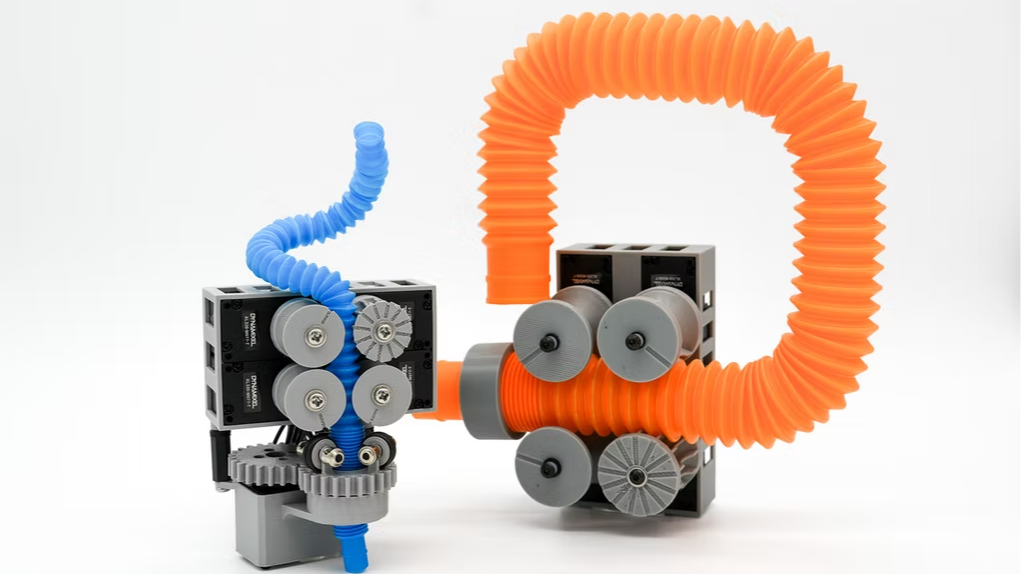
On one side, we have Generalist AI raising $400 million to build foundation models for general-purpose robots. On the other, researchers at the University of Amsterdam just released plans for RoboChem Flex — an autonomous chemistry robot that costs $5,000 instead of the usual $50,000-plus. Down the hall, metaphorically speaking, the University of Chicago's Actuated Experience Lab is bending pop tubes into 3D shapes with five motors and some clever gearing.
The contrast is stark. One path leads toward massive compute, enormous datasets, and the kind of capital that requires venture backing measured in hundreds of millions. The other involves 3D printers, modular design, and the kind of scrappy engineering that used to define the field before it became an asset class.
Here's what's interesting: both approaches might be essential, but only one is accessible to the researchers, educators, and tinkerers who will actually push robotics into unexpected places.
RoboChem Flex isn't just cheaper — it's designed to be replicated. The team used off-the-shelf components and open documentation specifically so other labs could build their own versions. This matters more than the cost savings alone. When a chemistry optimization system drops from luxury research equipment to the price of a used car, it stops being a tool for elite institutions and becomes something a motivated graduate student or small company can deploy.
The pop tube bender project, meanwhile, demonstrates something we're seeing more often from university labs: a willingness to explore robotics applications that have no obvious commercial path. There's no venture capital pitch for a device that shapes children's toys into temporary 3D forms. But there might be insights about compliant mechanisms, rapid prototyping, or human-robot interaction buried in that work — insights that won't emerge if every project needs to justify itself with a Series A deck.
This isn't an argument against well-funded robotics companies. Generalist AI's work on foundation models requires resources that universities simply can't marshal. Boston University's AGROBOT winning the MassRobotics challenge shows how academic work can complement commercial development. The issue is balance.
Right now, the robotics conversation is dominated by deployment scale, production numbers, and funding rounds. GENISOM AI ships 10,000 quadrupeds. Amazon upgrades Proteus for European warehouses. ANSCER raises $5.4 million for industrial AMRs. All important, all necessary. But if the only robots being built are the ones with clear paths to revenue, we're going to miss entire categories of innovation.
University labs have always played a specific role in the robotics ecosystem: they explore dead ends, test weird ideas, and occasionally stumble into breakthroughs that nobody saw coming. They can only do this if the barrier to entry stays low enough that a small team with a modest budget can still build something meaningful.
The fact that researchers are actively working to lower those barriers — not just for themselves, but for anyone who wants to replicate their work — suggests they understand this. Whether the industry pays attention is another question entirely.
We're at a moment where robotics could bifurcate into expensive, commercially-viable systems on one side and inaccessible research on the other. Or we could maintain space for the cheap, strange, and experimental work that tends to produce the ideas everyone copies five years later. The universities building $5,000 robots are making a quiet argument for which path we should take.