
When Did Robots Start Needing Therapists?
There's a curious pattern emerging in robotics labs that has nothing to do with actuators, sensors, or motion planning. Researchers are increasingly focused on making robots that don't just move like us, but feel like us — or at least convince us they do.
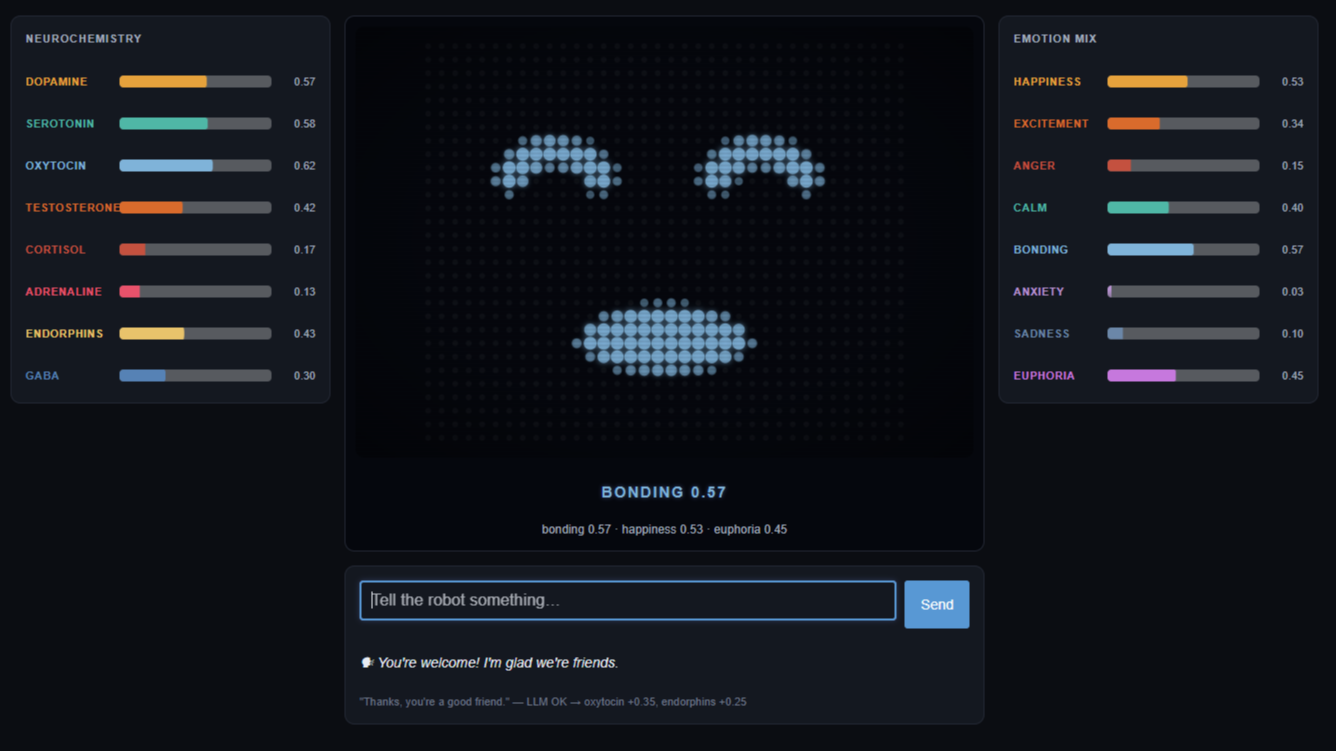
Drew Smith's Kindalive project represents the bleeding edge of this trend. Rather than programming emotional responses through conventional sentiment analysis, Smith simulates eight neurochemicals — dopamine, cortisol, serotonin, and others — to generate what he calls 'believable emotional states.' The system models how these chemicals decay and interact, essentially giving robots a simplified endocrine system. It's not just novel; it's a fundamental rethinking of how we approach robot personality.
This comes alongside MIT's ultrasound wristband that enables robots to mirror human hand movements with unprecedented fidelity. While that technology focuses on physical mimicry, the underlying motivation is the same: closing the gap between human expression and robotic response. When you can control a robotic hand as naturally as your own, the machine begins to feel less like a tool and more like an extension of yourself.
The timing of this psychological turn in robotics isn't coincidental. As robots move from controlled factory floors into homes, hospitals, and public spaces, their emotional legibility becomes critical. A warehouse robot can be purely utilitarian, but a service robot that can't signal its intentions or emotional state becomes unsettling, even threatening. We're hardwired to read faces and body language; robots that operate in human spaces need to speak that language.
What's particularly interesting about the neurochemical approach is its departure from the 'fake it till you make it' school of robot emotion. Previous systems often relied on pre-programmed facial expressions or tone modulation — essentially theater. By contrast, simulating the actual biological mechanisms that produce emotion in humans creates emergent behavior that's harder to predict but potentially more authentic. A robot running a neurochemical simulation might surprise its creators with reactions they didn't explicitly program.
This raises uncomfortable questions about what we're actually building. If a robot exhibits emotional states derived from simulated biology, at what point does dismissing those states as 'not real' become philosophical hair-splitting? We're edging toward a future where the Turing test isn't about fooling someone in conversation, but about creating machines whose emotional responses are indistinguishable from ours in everyday interaction.
The practical implications are already visible in industries like elderly care and education, where robot acceptance hinges on emotional connection. A therapy robot that can't read or express emotion appropriately is worse than useless — it's cruel. The same applies to classroom robots, companions, and service workers.
What's emerging is a robotics industry that's finally taking seriously what science fiction understood decades ago: the hardest part of building useful robots isn't the engineering, it's the psychology. Making a machine that can navigate a room is hard. Making one that can navigate a human relationship is exponentially harder. The researchers simulating neurochemicals and mapping muscle movements aren't wasting time on frivolous features — they're building the foundation for robots that can actually live among us.
The question isn't whether robots need therapists. It's whether we're ready for robots sophisticated enough to need them.