

Why Is Everyone Suddenly Making Robotics More Affordable?
Something unusual is happening in robotics right now, and it's not about the latest humanoid doing backflips or an AI model breaking benchmarks. It's about price tags—and more specifically, how they're dropping fast enough to fundamentally reshape who can participate in the robotics revolution.
Consider RoboChem Flex from the University of Amsterdam. Researchers managed to compress an autonomous chemistry synthesis robot—previously a $50,000+ investment—down to roughly $5,000 using 3D-printed components and modular design. That's not an incremental improvement. That's a 90% cost reduction that transforms laboratory automation from the exclusive domain of well-funded research institutions into something a graduate student could conceivably crowdfund.
This isn't an isolated case. Festo's new HPPH pneumatic gripper integrates controls and safety functions directly into the gripper body, reducing both weight and the rats' nest of wiring that typically accompanies collaborative robot deployments. By consolidating components, they're not just making the hardware lighter—they're making the total cost of ownership more palatable for smaller manufacturers who've been priced out of automation.
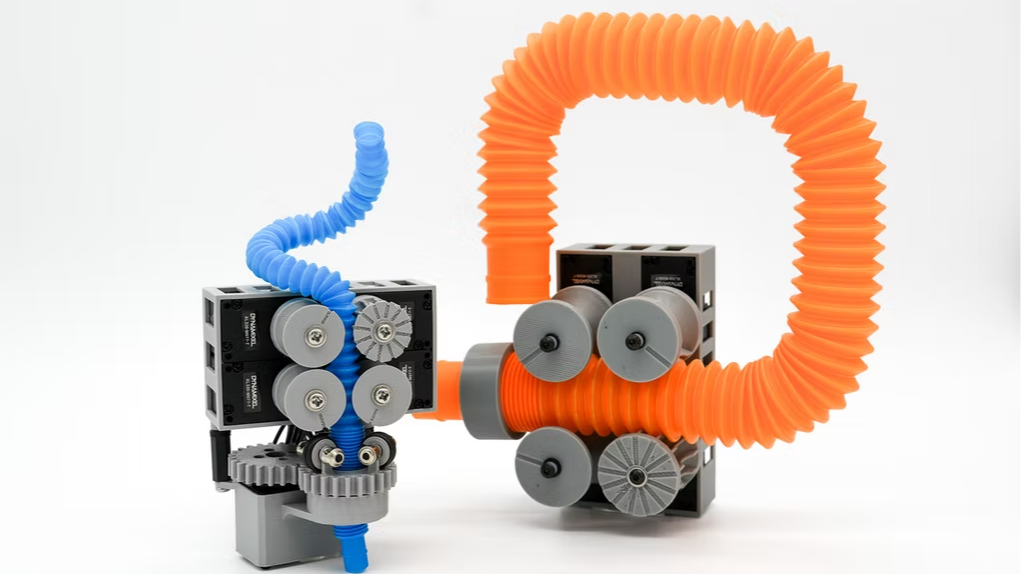
The pattern repeats across segments. ANSCER Robotics is targeting complex manufacturing environments in India with hybrid AMRs designed specifically for cost-sensitive markets. PopTuber from the University of Chicago demonstrates how creative engineering with commodity components—five motors and specialized gears—can create novel robotic systems for physical prototyping without enterprise budgets.
What's driving this democratization wave? Partly, it's the maturation of core technologies. Motors, sensors, and computing power that once required custom engineering can now be sourced off-the-shelf. Open-source frameworks have reduced software development costs. And critically, manufacturers are discovering that the real money isn't in selling premium hardware to the Fortune 500—it's in volume sales to the massive middle market that's been underserved.
But there's a darker undercurrent here too. As robotics becomes more accessible, the competitive moat narrows. Companies that built their businesses on proprietary systems with hefty price tags are watching startups undercut them with 'good enough' solutions at a fraction of the cost. The University of Amsterdam didn't need Agilent or PerkinElmer to validate their chemistry robot—they just needed GitHub, a 3D printer, and Bayesian optimization algorithms that are freely available.
The QNX research finding that software architecture has become the biggest bottleneck in robotics development is relevant here. As hardware commoditizes, the differentiation moves up the stack. The winners in this new landscape won't be the companies with the most expensive components—they'll be the ones who can deliver reliable, integrated systems that work out of the box, regardless of price point.
For the robotics industry, this democratization is both opportunity and threat. Yes, accessible technology expands the total addressable market. But it also means the barriers to entry are collapsing. That graduate student with the $5,000 chemistry robot? They might just be your next competitor.
The revolution won't be televised. It'll be 3D-printed, open-sourced, and deployed in places that never could have afforded automation before. And that changes everything.