

Your Robot Wants to Touch Things Now
The robotics industry has spent the last decade obsessing over vision and decision-making. We've watched robots learn to see, navigate, and increasingly think. But this week's news reveals something different brewing: robots are finally learning to touch.
Consider Carnegie Mellon's Text2TactileGraphics system, which converts text prompts into 3D-printed tactile graphics for people with visual impairments. It's not just another accessibility tool—it represents a fundamental shift in how we think about human-robot interaction. The system doesn't just display information; it translates abstract concepts into physical sensations, creating raised shapes and textures that communicate through touch alone.
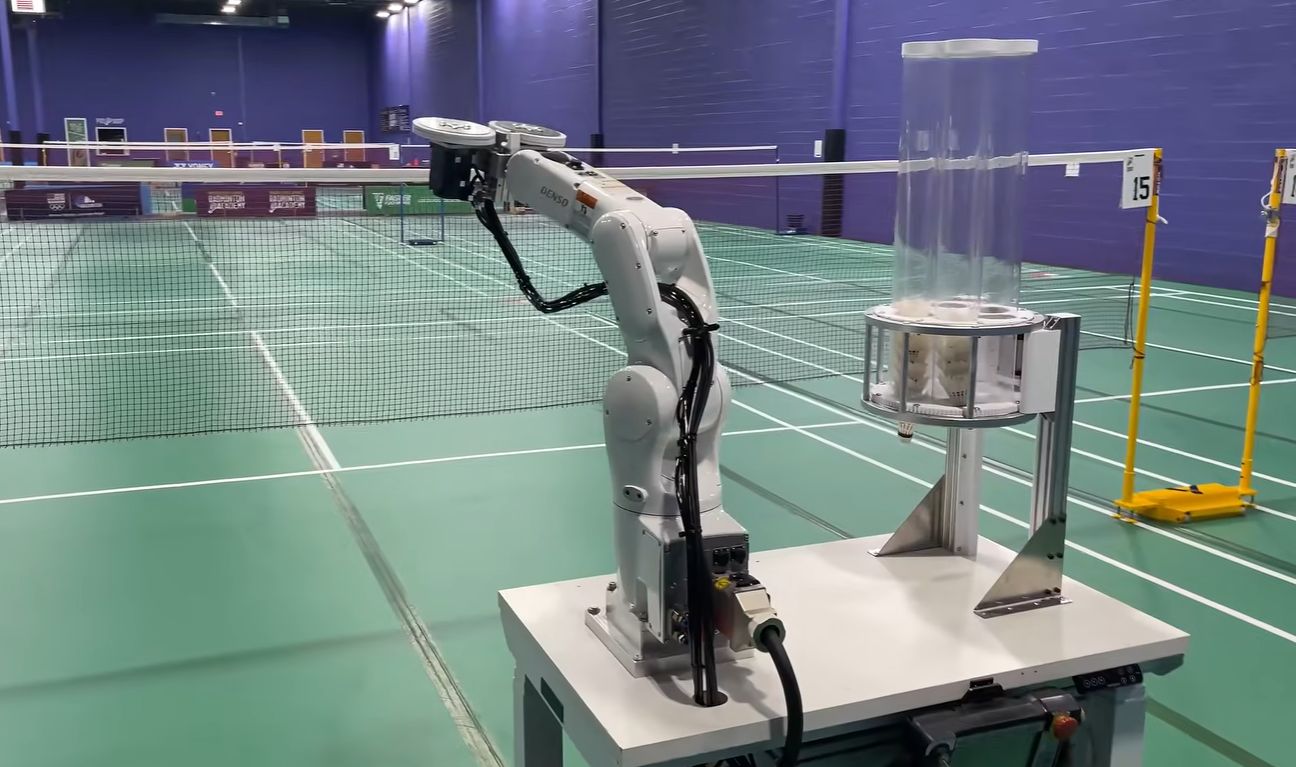
Meanwhile, a hobbyist engineer converted a Denso industrial arm into a badminton shuttlecock server, incorporating a pneumatic grabber that feeds shuttlecocks into spinning wheels. It's easy to dismiss this as a weekend project, but the engineering challenges mirror what robotics labs face daily: how do you reliably manipulate objects with varying shapes, weights, and fragility?
The pattern extends further. Meta's data center robot initiative isn't just about automation—it's about robots that can handle physical infrastructure with enough dexterity to reset servers, manage cables, and perform tasks that currently require human hands. Berkeley's sub-$5,000 humanoid robot achieves its low cost partly through clever actuator design, but those actuators exist to enable precise physical manipulation.
Even the RoboCup humanoid soccer match, while showcasing locomotion and teamwork, ultimately comes down to one thing: can these robots control a physical ball well enough to play a recognizable game?
For years, the robotics community treated manipulation as a solved problem for industrial applications and an impossible one for general-purpose robots. The middle ground—robots that could handle everyday objects with reasonable reliability—remained frustratingly out of reach. Computer vision improved dramatically. Path planning became sophisticated. But actually grasping, holding, and manipulating objects? That stayed hard.
What's changed isn't a single breakthrough but a convergence of technologies. Better sensors provide richer haptic feedback. Machine learning models can now predict how objects will behave under different gripping strategies. 3D printing enables rapid iteration on gripper designs. And crucially, roboticists are finally treating tactile interaction as a first-class problem rather than an afterthought.
The implications extend beyond robotics labs. As AI agents become more capable at digital tasks, the bottleneck shifts to physical execution. An AI can plan the perfect warehouse layout, but someone—or something—still needs to move the boxes. Language models can write surgical procedures, but hands must perform them.
The Berkeley Humanoid Lite's open-source release is particularly telling. By making sophisticated manipulation hardware accessible and affordable, it democratizes experimentation in the same way that Arduino boards did for embedded systems. Expect a wave of graduate students and hobbyists exploring manipulation problems that were previously the exclusive domain of well-funded labs.
We're not yet at the point where robots can match human dexterity. But for the first time, we're seeing coordinated progress across the entire stack—from hardware design to control algorithms to machine learning models that understand object physics. The robots learning to serve shuttlecocks and create tactile graphics today are the foundation for robots that will handle far more complex physical tasks tomorrow.
The AI hype cycle has focused relentlessly on intelligence and reasoning. But intelligence without the ability to interact meaningfully with physical objects is just expensive computation. The real robotics revolution might not be about robots that think better, but robots that finally know how to touch.